It's a must that I link to Dan Connolly's article "O's power trip leads to Eutaw Street," which provides an overview of Eutaw Street home runs and the intrigue that surrounds hitting the Warehouse on the fly.
Connolly uses the occasion of Ken Griffey Jr.'s (potentially last) visit to Baltimore to tell the Eutaw Street story. Griffey was the first player to hit the Warehouse, albeit during the All-Star Game's Home Run Derby.
Connolly uncovers some new ground, at least for me, in providing the names of players to hit the Warehouse in batting practice: Jay Gibbons, Walter Young, Carlos Pena, and David Ortiz.
Young, the heaviest player in major league history, would make for a fun bit of baseball trivia had he been the first one to hit the Warehouse in game action. However, Young hit just one home run for the Orioles, and it came on the road at Texas.
Young played alongside Jose Lima last summer with the Edmonton Capitals of the Golden Baseball League.
Something tells me that Sam Horn could've done it had he played more games at Camden Yards. Horn predicted as much back in 1992, telling the Washington Times: "When I hit one really good, I'll hit the warehouse. I may not be the first to do it and I don't want to talk too much, but I will be putting in my effort."
Griffey is unlikely to match his effort this week given that it would require him to stay awake for a full nine innings.
Connolly's article serves as a nice reminder that I need to get cracking on more entries for the Eutaw Street Chronicles, which tell the back story behind each home run to land on the walkway.
Here's the Eutaw Street Chronicles archive.
-30-

Tuesday, May 11, 2010


Friday, May 07, 2010
Flashback Friday: He earned one career victory, and it came against the Red Sox
"I only got a couple cups of coffee. But they were good cups."
-Former Orioles pitcher Mark Brown

Brown earned one major league win in 15 relief appearances. It came at Fenway Park on the last day of the 1984 season. Baltimore's staff ERA was second best in the majors that year.
Brown's line for the day read as follows: 2.0 IP, 1 H, 0 R, 0 ER, 1 BB, 2 SO. But as always, the full story is better than a single line.
Here's how it went down, as described by Jeremy Rosenberg of SABR's Baseball Biography Project.
It's September 30, 1984, an early autumn Sunday afternoon in Boston's Kenmore Square. The trees are already tinged with red, yellow and orange; soon the Green Monster will be the only thing still green. Inside Fenway Park, a righthander is warming up in the visitors' bullpen. He's built like a ballplayer -- 6'2", 190 lbs., according to his baseball card -- and wears his tri-colored cap stiffly, with little curve in the brim. He's got his road grays on, with "Orioles" stitched across his chest in orange script. His black Nike cleats have swooshes so visually loud they're practically flourescent.Two batters before Rice, Brown struck out Wade Boggs. So in the process of earning his first and only major league win, Mark Brown struck out two future Hall of Famers.
In the bottom of the sixth inning, the bullpen gate opens and the righthander heads for the mound. He's a struggling rookie, still winless after eight major league appearances; now it's the last game of the season, his last chance to pick up a victory. In the stands, his father takes in the moment, thinking about how the two of them used to come each summer to this very place, a mere three-hour drive from home.
Two innings later, Jim Rice is standing frozen at the plate and the righthander is sprinting off the field, afraid to look back. If he does, he's sure the umpire will wave him back, tell him there's been some sort of mistake; rookies aren't supposed to get any breaks, especially when facing future Hall of Famers. But in this case the rookie threw the exact same pitch twice in a row -- a nasty slider on the outside corner. The first time the umpire called it a ball, in deference to Rice. But not the second time.
In the top half of the inning, the Orioles scored twice on a Wayne Gross single to break a 3-3 deadlock and take the lead for good. Nate Snell and Sammy Stewart come on to finish the game for Baltimore, and the rookie's pitching line in the box score that appears in the next week's issue of The Sporting News reads: "Brown (W 1-2) 2 1 0 0 1 2." As a souvenir, pitching coach Ray Miller gives Brown a game ball. Written between the stitches is the date, the score, the teams, the time and the glorious words "First Major League Win."
Things went considerably better with the last batter Brown faced as an Oriole than they did with the first batter he faced. Again, Jeremy Rosenberg tells the story.
The first big league batter Brown faced, Julio Franco, smashed a line drive off his knee. To add insult to injury, the hit went for an infield single, and, worst of all, it came on what Brown thought was a good pitch. "I threw him a real nasty slider on the outside corner and he took it right off my kneecap. [The ball] just trickled over to first base. I hobbled over there and just watched him run to first, and he was safe." Brown pitched on and was hit hard. He gave up another hit, Cal Ripken made an error and a 4-4 tie was suddenly a 6-4 deficit. "I had my first appearance, my first loss and my first sore knee," Brown says. "I finished the inning, then [manager] Joe Altobelli took me out. He thought I might hurt my knee more by throwing for another few innings."Brown finished his Orioles career 1-2 with a 3.91 ERA, 10 strikeouts, and seven walks.
"It was alright, it wasn't really hurt bad," Brown says. "It was funny, I got to the clubhouse and I remember Mike Flanagan coming up to me, patting me on the back, saying, 'Oh yeah, welcome to the big leagues, even the outs here are hard.'" Brown says those words from a fellow New Hampshire resident meant a lot to him, as did the treatment he received during each of his five summers in the Baltimore chain. "They were a great organization," he says. "When I went well, they promoted me; when I was hurt, they put me on the disabled list; when I got to the big leagues they were good to me, they gave me a shot."
Of his brief time in the majors, the Vermont native said: "I only got a couple cups of coffee. But they were good cups."
Image source: Here.
-30-
Thursday, May 06, 2010
Tales from the Baltimore Baseball Cruise

"Former first baseman Sam Horn achieved legendary status one year when he strutted on stage during a passenger talent show clad only in a towel."
In searching for information for my latest Camden Chat post "Rookie of the Year in Minnesota, burnt to a crisp in Baltimore," I came across this photo of Marty Cordova and Jay Gibbons. It comes, presumably, from a past Baltimore Baseball Cruise.
Cordova was a regular on the Orioles Cruise, including the January 2004 voyage, during which Sidney Ponson agreed to a three-year, $22.5 million extension with the Birds.
From the Jan. 15, 2004 Baltimore Sun:
Ponson agreed to the deal on a cruise ship off the coast of St. Thomas in the Virgin Islands. He has been making his annual guest appearance on the "Orioles Cruise," with Hall of Fame first baseman Eddie Murray, longtime bench coach Elrod Hendricks, and outfielders Jay Gibbons and Marty Cordova.But the good times on past cruises clearly extended beyond just contract signings.
Carolyn Spencer of The Washington Post wrote about the Orioles cruise back in 1999. She talked with a cruise organizer who described the process of selecting players for the journey.
He looks for athletes with star power and name recognition. Veterans who can tell colorful stories at dinner are valued. Those who have the 'it' quality--a mix of showmanship, sense of fun and sociability, regardless of stature (or lack thereof)--are always welcome.Then she provided a rundown on popular players and their antics.
Players who have been big hits on the Baltimore Baseball Cruise over the past 13 years include Brady Anderson, Chris Hoiles, Billy Ripken, Arthur Rhodes, Brooks Robinson, Mike Devereaux and Earl Weaver. Former first baseman Sam Horn achieved legendary status one year when he strutted on stage during a passenger talent show clad only in a towel.
Anderson, who has taken three Orioles cruises, is responsible for attracting a lot of the younger (i.e., under 50) cruisers; says Nigro, he "attracted a lot of women those years." What a bummer, then, for the group's female contingent that on one trip, Anderson had a shipboard romance with a cruise staffer, according to cruise organizers.
Memorable for quite another reason was John Lowenstein, a one-time Orioles outfielder turned broadcaster, who on embarkation decided he hated his cabin and bagged the cruise entirely. He wasn't asked back.And here's a bit about Spencer's own experience.
Lee May and his wife, Terry, turned me on to the best place to buy saffron in Grenada; Eddie Murray slammed a spike my way during a volleyball tournament in Aruba; Fred Manfra, a news junkie, spent a lot of time in the ship's business center surfing the Internet for the latest developments in sports trades (and regular Baltimore weather reports).Read that again: "Eddie Murray slammed a spike my way during a volleyball tournament in Aruba."
Being able to share that story would alone make it worth the cost of the cruise.
The 2010 Baltimore Baseball Cruise took place in January and featured Tippy Martinez, Ross Grimsley, and members of the York Revolution.
-30-
Publish Post
Monday, May 03, 2010
The 2010 version of Ty Wiggington looks a lot like the 2008 version, at least for a month

Wiggington had arguably his best-ever month at the dish for the Astros in August 2008: 28 games, .379 average, 12 home runs, 26 RBI, .394 OBP, 1.200 OPS. That occasion resembled what he's now experiencing as an Oriole in at least three ways.
Miguel Tejada was a teammate
In 2008, Wiggington played third base next to shortstop Miguel Tejada in Houston.Wiggington's now at second base (at least for the time being) with Tejada at third.
Think those guys ever imagined they'd reunite, playing different positions in Baltimore two seasons later?
Constant lineup shifts were the norm
Wiggington is clearly not a creature of habit.
When asked which is his natural or preferred position on the field, baseball everyman Wigginton said: “I don't really have one. I just want to be in that batting order somewhere.”
Emphasis on somewhere.
During his torrid stretch with Houston in August 2008 Wiggington occupied seven different spots in the Astros' starting lineups. Think about that: seven different lineup spots in one month's time.
Wiggington batted first, second, third, fourth, fifth, sixth, or seventh depending on the day. He also pinch hit for the pitcher twice in the nine spot. Wiggington most often batted second, ahead of Tejada, but he also served as protection behind Tejada in the five spot on occasion.
Dave Trembley has taken a page from then-Astros Manager Cecil Cooper's playbook. So far this season, Wiggington has batted second, third, fifth, sixth, seventh, eighth, and ninth. Just like in Houston, that's seven different lineup spots in one month's time.
Rising to the Red Sox occasion
Wiggington officially proclaimed his status as a Red Sox killer over the weekend with his clutch hitting at Camden Yards. However, this is not new territory for Wiggington.
Consider his career numbers against Boston: 45 games, .303 average, 12 home runs, 24 RBI, .370 OBP, .963 OPS.
The home run and slugging numbers are the best he's posted against any opponent. His OPS split against the Red Sox relative to his total OPS is 142.
In 2008, the Astros faced the Red Sox twice in Interleague play, and Wiggington delivered with a 429 average, home run, RBI, .429, OBP, and 1.571 OPS.
Wiggington's home run came in the bottom of the eighth inning on June 28, 2008 and tied the game between the Astros and Red Sox. The Astros won by one run as part of a sweep of the Red Sox (two games rather than a glorious three-game sweep).
Sound familiar?
-30-
Friday, April 30, 2010
The Unofficial Camden Yards Visitor's Guide: Boston Red Sox Edition

Boston has many great baseball fans. Unfortunately, they tend not to be the ones who show up at Camden Yards when the Red Sox are in town. Nevertheless, we hope you enjoy your visit.
If it's not too much to ask, we'd like for our fans to enjoy their visit to the ballpark as well. It only seems fair given it's the home team and all.
So here are a few things to remember as you prepare for your weekend at the ballpark:
-The Yankees aren't playing in Baltimore this weekend. They just left town. If you really want to find them, just look up in the A.L. East standings. No, not that high. Those are the Rays. Just a little lower. Okay, that's better.
Given New York's absence, there's really no need to start "Yankees Suck" chants at Camden Yards. Don't get me wrong, we would've appreciated your help earlier this week. Perhaps you can come back for an actual Yankees game in the future and try your chant out then.
-Speaking of the Yankees, please don't complain to the locals about New York's payroll or claim that your franchise is so different from the "Evil Empire." Take a look at the teams down on the field. One of them currently has a payroll twice the size of the other. I'm a generous person, so I'll give you two guesses as to which one that is.
-Our music guy doesn't take requests, so "Sweet Caroline" won't be replacing "Thank God I'm a Country Boy" during the seventh-inning stretch.
We're glad you found a song to call your own. Fittingly, it's perfect for a drunken singalong. We have our own traditions, though, and they're not so new. We would appreciate if you respect them.
-Speaking of tradition, baseball did in fact exist prior to 2004. And the Orioles have a pretty good baseball history of their own that includes many years atop the American League East.
Perhaps it's a minor detail, but the Orioles have won three championships since moving to Baltimore in 1954; the Red Sox have won two in that period.
A.L. Pennants since '54? Orioles 6 - Red Sox 5.
A.L. East titles? Orioles 8 - Red Sox 6.
There's no question that Boston has had the Orioles' number in recent years, but let's not pretend it's always been that way.
-Despite the Orioles' struggles, some fans actually do want to root, root, root for the home team. Try to keep your harassment of them, and their kids, to a minimum. Even after you've stuffed the beer vendors' pockets.
-We know you can't get over your own creativity in calling Camden Yards "Fenway South." We have our own name for it here in Baltimore: the Boston Bandwagon. It seems that bandwagon has picked up quite a few passengers outside New England in recent years.
-Finally, you can call yourselves Red Sox Nation, but that doesn't mean everyone in the country roots for your team. Actually, it's just the opposite. By recent accounts, you're actually more hated than the Yankees. If you don't act civilized in our ballpark, it'll stay that way.
By the way, we like your girlfriend's pink hat.
-30-
Thursday, April 29, 2010
Joe Girardi's inconsistent philosophy on pitchers is typical Yankees hypocrisy at its best

"It's frustrating. He really wanted to win this game to clinch our division. Put those things together and you get some wildness."
-Joe Girardi, after Roger Clemens hit three Orioles batters in a 1999 game.
Somebody needs to set these kids in Baltimore straight. There's no reason to punch local sports favorite Mark Viviano; save your anger for someone who deserves it.
I'm thinking Joe Girardi could use a punch in the back of the head right now.*
Girardi, who shared words with Jeremy Guthrie in Spring Training, continues to gripe about Guthrie hitting Yankees batters with pitches.
Come on Jeremy, don't you know those guys in pinstripes are made of precious porcelain? Why do you think the Yankees pay so much for them?
Guthrie, no headhunter by anyone's estimation, apologized to Posada after the game.
"I wish he had better command in there," Guthrie said, "I wish I had better command. If I did, I think I would pitch much, much better and we’d all see better results. … The inability to command every single pitch, I’m frustrated by it as well. It’s part of the game. Like I said, I’m apologetic for the fact that if he were to miss some time, that would be a shame that it was a pitch that got away from me that had that result. But ultimately, I’m going out there and trying to compete. I don’t ever want to give up free base runners because I can’t afford those as we’ve seen throughout my career.”Meanwhile, Girardi admits that there's no intention behind the pitches.
“I don’t think he’s doing it on purpose, but he hits a lot of people. That’s frustrating for us. We know he’s going to pitch inside and I don’t have a problem pitching inside."So Guthrie apologized, no one thinks he's hitting batters on purpose, and everyone agrees he's allowed to pitch inside. Nevertheless, Girardi continues to make a big deal of it.
Such is life with the Yankees, the do-as-we-say-not-as-we-do arbiters of proper baseball behavior.
Because it's the Yankees, Girardi's pouting produces headlines like this one: "Jeremy Guthrie Doesn't Care for the Yankees."
Good choice, Joe. Let's beat up the nice guys in the press and defend the jerks (more on that in a moment). Here's some background reading on Guthrie for Girardi to do while he waits for his pitchers to actually throw the ball and his hitters to jog around the bases.
Let's take a closer look at the issue in a comparative way.
Orioles Insider provides the rundown on Guthrie's control problems:
"Actually, Guthrie doesn't hit a lot of guys, but he does hit a lot of Yankees. Guthrie hit nine batters in 200 innings last season, but five of them were Yankees. He hit seven batters in 2008 in 190 2/3 innings and three of those were also Yankees. That means that eight of the 16 batters he’s hit over the past two seasons wear Yankee uniforms."Fair enough.
Now let's consider the numbers for Roger Clemens, the guy Girardi caught for in New York.
In 1999, four of the nine batters Clemens hit with a pitch played for the Orioles: Roberto Alomar, Jerry Hairston, Charles Johnson, and Eugene Kingsale. Three of those batters were hit in the same game on Sept. 30, 1999. Just call it the Clemens hat trick.
Here's what Girardi had to say after that game:
"It's frustrating."So far, so good. He said the same thing about Guthrie. But you know there's more, right?
"He was fighting himself," Girardi added. "He really wanted to win this game to clinch our division. Put those things together and you get some wildness."Clearly, Guthrie isn't fighting himself and doesn't want to win. Otherwise, it would be okay for him to experience some wildness.
The moral of the story is that it's okay to expect some consistency when it comes to pitching but not when it comes to one's baseball philosophy.
This is typical Yankees hypocrisy.
Here was the Yankees' perspective regarding their acquisition of Clemens in 1999:
Of course, when Clemens reported to Legends Field in Tampa two days after the drade, some of the players he had drilled in the past were waiting for him. Shorstop Derek Jeter, who twice was on the painful end of a Clemens purpose pitch last season, had the same reaction as many of Clemens's new teammates: he welcomed his old nemesis into the family. "No one is happy when they're getting thrown at," says Jeter. "I wasn't happy about it, but it's over with."It was all a big joke once Clemens donned the pinstripes.
"He's not just a pitcher," says Cashman. "He's a animal. And he's our animal now."
As this New York Times article details, Chuck Knoblauch and Derek Jeter wore catcher's gear for a Clemens batting practice session in Spring Training that year, much to the delight of the players and coaches.
This passage sums things up nicely (emphases added):
There had been speculation that Clemens would have old scores to settle before being accepted. Clemens, after all, had thrown at Jeter so often that Jeter had wondered why, and Clemens had drilled Knoblauch and Scott Brosius and once stared down Joe Girardi. Heck, he probably had some sort of angry history with just about every position player in pinstripes.Jeremy Guthrie is no Roger Clemens. Thankfully.
But all is forgiven now that Clemens is with the Yankees. He will knock down opposing hitters in the months to come, no doubt, and his teammates will come to understand Clemens and understand why he does this; when an opposing pitcher drills a Yankee with a fastball, Clemens might hit two batters in response and the Yankees will be glad to have him. ''You like him,'' Yankees Manager Joe Torre said, ''once he's on your side.''
For what it's worth, no Orioles pitcher hit Joe Girardi with a pitch during his four seasons in a Yankees uniform. Given what we know about the guy, you have to admire the Orioles' restraint.
__________________
Here's some past reading on obvious Yankees hypocrisy:
"Remember when the Yankees hated Jerry Hairston Jr.?"
Girardi's Spring Training hypocrisy in 1998 regarding the Rays' on-field behavior
__________________
*Having listened to Viviano on the radio this morning, I think it's fair to mention the incident in a lighthearted way. I do not mean to suggest in any way that the assault itself is funny.
-30-
Monday, April 26, 2010
Okajima pitches like he belongs in the Baltimore bullpen

Okajima recorded a hold Friday despite allowing two hits and an earned run in two-thirds of an inning. On Sunday the O's pinned him with a blown save after he allowed three hits and two runs, both on Miguel Tejada's home run, in 1.1 innings pitched.
Believe it or not, this was business as usual for Okajima and the Birds.
Tejada has a .571 average, 1.429 slugging percentage, two home runs, and three RBI in seven plate appearances against Okajima. Meanwhile, Okajima's career ERA against the Orioles is 6.23. The O's have posted 18 runs against him in 27 games, the most of any team.
The Orioles also have the highest average (.280), most hits (28), and second-most doubles (7) and home runs (3) against Okajima in the lefty's brief career.
Perhaps Okajima is auditioning for a spot in the O's bullpen.
-30-
Friday, April 23, 2010
Low Tide in Durham

Final score: Bulls 10 - Tides 1 (box score).
And to think, this was supposed to provide me some relief from the Orioles' early struggles.
 Rhyne Hughes' bat has remained hot following a solid Spring Training. On Sunday, he extended what ended up being an 11-game hit streak to open the International League season with a home run and a double for Norfolk.
Meanwhile, Chris George provided four solid innings of relief work for the Tides.
Otherwise, the highlights were few and far between down on the farm.
 One of the prospects I was most excited to see, Josh Bell, went 0-for-4 with four strikeouts.
Most baffling at first glance was the performance of Chris Tillman, who many presumed would be the Orioles' fifth starter this season.
In a first inning that saw the Bulls bat around, Tillman uncorked two wild pitches, walked two, hit one, and allowed four runs. That's not to mention other pitches that Tillman bounced to the plate.
 Clearly something was amiss with the young righty, whose struggles to get his off-speed stuff over the plate turned his low-90s fastball into red meat for the Bulls.
Steve Melewski's conversation this week with Norfolk pitching coach Mike Griffin sheds some light on Tillman's struggles.
Griffin discusses Tillman's efforts to develop a cut fastball and improve some of his other pitches along the way. Definitely worth a read as it helps go beyond the easy theories of sulking and shattered confidence. Often times we fans have little to go on other than guess work. Melewski's article provides some depth.
More ballpark pictures below, including my personal favorite of Robert Andino channeling the Ratpack: "Me and My Shadow."
-30-


Thursday, April 22, 2010
Jim Palmer, brought to you by Bare Necessities

The sponsorship reads: "Find Jockey Elance underwear (and 120 other great brands for men and women such as Calvin Klein, Spanx, Emporio Armani, etc.) at BareNecessities.com!"
Well played, Bare Necessities. Well played.
-30-
Wednesday, April 21, 2010
Quality starts not leading to quality outcomes in Baltimore
The O's have lost six of the seven games in which the starter provided a quality start.

On Tuesday, the Orioles did what they have been doing best lately: waste a quality start.
Final score: Seattle 3 - Baltimore 0.
David Hernandez pitched 6.1 innings, gave up three runs, and took the loss. It's the second time this season the O's have lost a quality start by Hernandez, who gave up two runs in six innings in a 3-0 loss to the Blue Jays on April 10.
After struggling to find solid starting pitching for what has seemed like an eternity, the Orioles are finally getting it this season (with the sad exception of Brad Bergesen). The starting rotation has posted quality starts in nearly half the games this season (7 0f 15), which doesn't include two strong, five-inning efforts by Millwood and Matusz respectively.
Consider this: the O's have lost six of the seven games in which the starter provided a quality start. Brian Matusz holds the only win following a quality start, an 8-3 win against the Athletics on April 18.
Jeremy Guthrie's three quality starts are tied for the MLB lead, but he has yet to earn a win.
Here's what MLB.com's Bailey Stephens had to say about quality starts last week: "Quality starts are key to a team's success, even in the season's earliest games, as early divisional matchups can set the tone and make for a positive start to the season."
Not so much in Baltimore. Talk about setting a tone.
Blame the bullpen, and, of course, blame the bats. Baltimore is a major league-worst 16-for-107 (.150) with runners in scoring position. They are next to last - only Houston is worse - in run support average at 3.12.
Grow the arms and buy the bats? I suppose the Birds will be busy on the free-agent market following the season. Oh, and get well soon, B-Rob.
Orioles Quality Starts in 2010
April 7 - Jeremy Guthrie quality start (lost 4-3)
April 10 - David Hernandez quality start (lost 3-0)
April 11 - Kevin Millwood quality start (lost 5-2)
April 12 - Jeremy Guthrie quality start (lost 5-1)
April 17 - Jeremy Guthrie quality start (lost 4-3)
April 18 - Brian Matusz quality start (won 8-3)
April 20 - David Hernandez quality start (lost 3-1)
Image Source: Here.
-30-
Tuesday, April 20, 2010
The O's: Part punching bag, part punch line in Boston

Many newspapers have an in-house guide to supplement the Associated Press Stylebook. I'm guessing the Boston papers share a sports stylebook that includes a special entry for the Baltimore Orioles: "metaphor for futility; use often to highlight the disparity between the haves and have nots."
It only make sense given the focus on Baltimore no matter whether the Red Sox are winning or losing.
Right now the Red Sox are losing. So earlier this week, in the column "Hot ticket, lousy team," Steve Buckley couldn't resist a shot at the Orioles' more considerable struggles.
The Red Sox hit rock bottom last night/this morning. We’re not talking about rock bottom in the American League East (that dis-honor goes to the Baltimore Orioles, who will be lucky to win 50 games).Thanks, Steve, for mentioning the Orioles in the same sentence as the mighty Red Sox.
Here's hoping Buckley's simply prone to bouts of severe hyperbole. The O's are off to an awful start, but lucky to win 50 games? Heck, the '88 team won 54 games after losing 21 straight to open the season.
But this is nothing new. Let's rewind a bit.
Last year the Red Sox set of waves of panic in New England when they started losing toward the end of the season to teams including, to use their words, "the mediocre Chicago White Sox." As the storyline went, the losses were an indication that the Red Sox couldn't beat good teams.
Who to blame for Red Sox Nation's inflated sense of self? Why the Orioles, of course.
Take it away, Tony Massarotti.
The ballpark is one thing. The competition is quite another. And at this stage, we can only wonder where the Red Sox would be without the generous assistance of the Baltimore Orioles.Fair enough, I suppose. Although I might ask where the Red Sox would be without the generous assistance of a payroll ($162 million) twice as large as that of the Orioles ($81 million) in 2010 and roughly $100 million larger than those of the Rays ($71 million) and Blue Jays ($62 million).
Shut down by the mediocre Chicago White Sox over the weekend, the Red Sox returned to Fenway Park last night and took out their frustrations on the Uh-O's, pounding Baltimore by a 10-0 score in a game that wasn't nearly that close. The Sox hit five homers before making nine outs, improving to 12-2 against the Orioles this year. Nonetheless, the Sox saw their lead dwindle to two games in the American League wild card race thanks to the Texas Rangers' doubleheader sweep of the Cleveland Indians.
...
If last night's resounding victory surprised or inspired you, it shouldn't have. There is too much else to consider at this point. No team in baseball has more wins over one opponent this season than the Sox do over the Orioles. Last night's win made the Sox a sterling 12-2 against Baltimore this year, a record that includes an unforgettable 11-10 loss on June 30 in which the Sox somehow blew a 10-1 lead. This year, the Sox have not lost a game to the Orioles in which the Boston starter was anyone other than John Smoltz.
The Orioles have not been the Sox' only punching bag. The Sox are 11-4 against Toronto (another doormat) and went 11-7 against the inferior National League. That leaves the Sox at 46-45 against everyone else. All of this suggests the Sox are far closer to being a mediocre team than they are an elite one.
Sorry if the rest of the A.L. East inflates your hopes with their paltry salaries and competitive imbalance. Better to ignore that and stick to a popular storyline: "How dare the Orioles get our hopes up?"
That September storyline continued on through the post-season, where the Red Sox lost to the Angels. This time it was Dan Shaughnessy's turn to take his licks.
There was nothing fluky about this outcome, folks. It was a three-game sweep, a Boston beatdown in which all of the locals’ flaws were exposed. Just as we feared, the 2009 Red Sox were artificially enhanced by home-field dominance (56-25 at Fenway) and a lot of games against the Triple A Orioles. Ultimately, the Franconamen were a team with too many holes to win a World Series.The Red Sox went out and bought the top pitcher, John Lackey, from the team that beat them for $82.5 million. Not that the Red Sox - second only to the Yankees in spending in 2010 - are anything like New York mind you. That storyline's unacceptable.
"Rock bottom" ... "Uh-O's" ... "Triple A Orioles."
If ever there were a reason to enjoy the Rays' mastery of the Red Sox (Was that four-game sweep the Orioles fault as well?) and cheer for Tampa Bay to win the East.
On a related note, check out Baltimore Sports Report's contest to explain, in five sentences or less, why you hate the Red Sox. The winner gets two tickets to the April 30th O's - Red Sox game at Camden Yards. The entry deadline is 5 p.m.
Image source: Pictures depot.
-30-
Monday, April 19, 2010
Sizing up the best & worst Aprils in Orioles history

Baltimore never had a losing April from 1960-1969 and finished the '60s with their best overall April record (91-62).
The Orioles doubled their win total on Sunday with an 8-3 victory against Oakland that guaranteed they won't match the worst April record in team history, the 1-22 mark posted by the 1988 team.
The 2-11 Birds now need to record an unlikely 10 straight victories to close out the month with a winning record. Otherwise, the franchise will be even-Stephen overall for the month of April with 25 winning Aprils, 25 losing Aprils, and seven .500 Aprils.
Here's a breakdown of how the Orioles have done historically in the fourth month of the year and traditional first month of the baseball season:
-The O's best April mark was 11-1 in 1966. Baltimore never had a losing April from 1960-1969 and finished the '60s with their best overall April record (91-62, .594 winning percentage).
-After 1988, the team's next-worst opening months came in 1955 (4-12, .250 winning percentage) and 1999 (6-16, .272). Among the teams to post the three worst Aprils in team history, only the 1999 Orioles had some fight left in them. The '99 team finished 78-84 while the 1955 Orioles went 57-97 and the '88 Orioles were 54-107.
-The '50s and '80s were the worst decades for the Birds in terms of their April record. The O's finished the '50s (1954-1959) with an April record of 33-50 (.397 winning percentage) and the '80s (1980-1989) with an April record of 85-116 (.422 winning percentage).
-The O's actually were pretty good in April throughout the 2000s. The team finished the decade with a 128-177 record (.522 winning percentage) for the month. The 2009 Orioles had the worst April record of the decade (9-13). The best Aprils came in 2005 (16-7) and 2008 (16-11).
-Baltimore's highest April win total is 16, which they've done four times (1969, 1997, 2005, 2008).
As I've mentioned before, I'm hoping the 2010 Birds resemble the 1999 Birds among slow-starting Orioles teams when it's all said and done.
Image Source: SI Vault (Oct. 10, 1966).
-30-
Friday, April 16, 2010
Baltimore's baseball anthems just got better
Haven't seen the Scott Stapp video "Marlins Will Soar"? Good for you.
The beauty of ballpark anthems is typically in the eye of the beholder, but in this case there's not much to debate. Stapp's effort introduces a whole new category of bad baseball song.
If you really must, check out Stapp's video below.
I particularly like when Stapp establishes his baseball credentials by offering a rundown of what he knows about the sport:
One strike, two strike, swing away ...
A diving catch, a stolen base ...
A perfect game, a triple play ...
The groupies after games.
Whoops. Seems I'm getting that last one confused with a different Scott Stapp video.
And was there something in there about a perfect game? That's genius. Look at the way he uses irony. The Marlins are one of 11 teams, including the Orioles, to never have been involved in a perfect game on the winning or losing side.
Below is a rundown of some Orioles songs that no longer qualify as even remotely bad. Heck, they could all be Grammy winners at this point. Thank you, Scott Stapp.
For me, nothing tops Jason Siemer's "A World of Orioles Baseball." I get the sense it's the type of thing Florida was going for with "Marlins Will Soar." They just missed out on the passion, nostalgia, and everyday guy singing the song. Those are three elements that contribute to a quality ballpark anthem. You could have one, two, or even swing away.
"Welcome Home"
"Orioles Magic"
"A World of Orioles Baseball"
"Birdland"
"How Bout Dem O's?"
-30-
No matter how many or few, blown saves tend to stick in a fan's mind

I'm not talking present tense. That's easy.
Rather, I'm talking about the guy who so made your stomach turn during his career that, fairly or not, you feel like grabbing the Maalox at the mere mention of his name.
(I know, I know, I should've chosen Rolaids instead of Maalox.)
For me, that guy is Gregg Olson.
Remember the disclaimer I offered in that earlier sentence, "fairly or not"? Well, it's clearly not fair that Gregg Olson is my archetype for the blown save.
Olson was a great closer.
First reliever to be American League Rookie of the Year.
An All-Star in 1990.
An Orioles Hall of Famer (and Omaha Sports Hall of Famer for that matter), he is the team's all-time saves leader. Olson saved 160 games in Baltimore and had a save percentage of 83 during five full seasons.
The guy was so good he earned a nickname for himself (Otter) and his curveball (Uncle Charlie). The last time anyone had two nicknames for me it started with Tweedledee.
Here's what Tom Boswell wrote in The Washington Post after Olson blew a save against the Yankees on June 8, 1990.
On Friday night at Memorial Stadium an amazing, stupifying and altogether almost unbelievable event transpired. The capacity crowd could only gasp in incredulity, too stunned to respond.
Gregg Olson gave up a run.
And he blew a save.
Olson had not allowed a run here since July! And he'd permitted only one run-o-n-e r-u-n-in his previous 42 appearances, encompassing 61 innings since July 31.
Of course, he knew he couldn't flirt with perfection forever.
"I knew that it couldn't keep up, but I kept telling myself that it might," said Olson.
Clearly, my mind's eye lacks 20-20 vision.
The game I most remember from Olson's career happened on June 19, 1991, one year after Boswell's article.
It's not just that I attended that game with my family and saw the meltdown in person, although that's part of it. I remember that game because Olson threw his uniform in the trash can afterward.
Olson, pitching in relief of Jeff Robinson with a 4-3 lead surrender five runs - FIVE RUNS - to the Twins in an 8-4 loss. It was Turn Back the Clock Day in Baltimore honoring the 1966 team.
When you're a kid, and a guy blows a save on the day you went to the game, on the same day the team was wearing cool-looking uniforms, and you hear the pitcher literally tossed his uni in the trash ... that's not the kind of stuff you forget.
Last week, on Opening Day in Baltimore, the Orioles honored the 1970 team. The O's took a one-run lead into the ninth inning before the team's closer blew the save. It was much the same set-up that years earlier created an unfair image of Gregg Olson in my mind.
But as far as I know, Michael Gonzalez didn't toss his uniform in the trash after the game.
[This story appeared Thursday afternoon on Camden Chat.]
-30-
Thursday, April 15, 2010
The 2010 Astros are not the 1988 Orioles

It's never too soon to overreact to losing.
That's why, after just seven games, the question already has been posed: "Could the Houston Astros become the '88 Orioles?"
Here's an excerpt from The Big Lead.
The Houston Astros flat-out suck. They’re 0-7. Worst start in MLB history to begin a season: Baltimore Orioles, 1988 edition, going 0-21 off the top. Here’s the Astros’ schedule. For reference, here’s that 1988 Orioles roster: team finished 54-107, but wasn’t too awful – Tettleton, both Ripkens, Eddie Murray, an aged Freddy Lynn. Problem: their top four pitchers all had at least 12 losses. Question beckons: can the 2010 Astros drop 14 more, or even get close?Back off, Houston, that's Baltimore's futility record.
...
Short answer: no. It’s conceivable to think of Houston losing the next two in St. Louis and getting swept at Wrigley – Cubs’ offense has been putrid, but still, it’s Wrigley and spring is in air for the Bums – but dropping nine at home, including six to Pittsburgh and Cincinnati, would almost be too much to bear for an organization that was in the World Series a half-decade ago.
They won’t be the 1988 Orioles, but still, here’s some issues we unearthed regarding the 2010 Astros. We won’t even reference No. 3 starter – NUMBER THREE!! – Bud Norris, who has no business being in a rotation right now.
I make that remark jokingly, but I admit I've developed a certain sense of nostalgia about the 1988 team.
"Fantastic Fan Night" alone makes me proud to be an Orioles fan.
Name another franchise that could attract more than 50,000 fans to a homecoming celebration after the team played the worth month of baseball in history. [Do yourself a favor, and read this article.]
Jon Miller - yes, the same Jon Miller who's covered some of baseball's greatest moments- counts Fantastic Fan Night among his most memorable games.
But it wasn't just one display of pride.
I can remember going to school and having the O's losing streak be discussion topic No. 1 in Homeroom (You did have Homeroom at your school, right?).
Included among the talk was The Sun's headline that included an "O" for each loss at the start of the world Orioles. (O-O-O-O-O-O-O-O-O-O-O-O-O-O-O-O-O-O-O-Orioles).
Would we all rather have been talking about World Series possibilities? Sure. But there was a sense of unity around the team. Our team.
That sense of unity carried over from Homeroom to math class where our teacher, an usher at Memorial Stadium during the summers, showed videos of past Orioles World Series triumphs each year at the start of the baseball season.
I learned in school that we stuck by the O's, win and lose.
That's why I like the fact that my Orioles franchise hat has the year 1988 on the back of it.
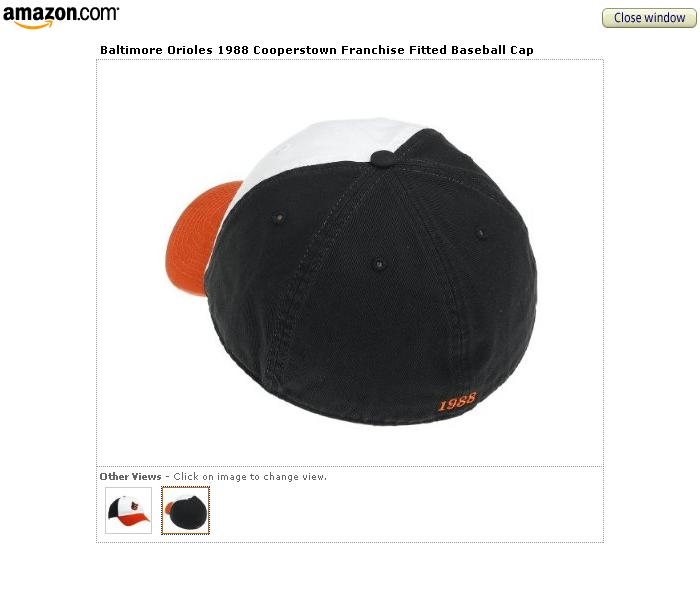
It would be difficult, to say the least, to muster the same kind of passion in Baltimore these days.
Whereas the 1988 Orioles weren't all that far removed from the franchise's glory years, the 2010 Orioles haven't seen a winning season in more than a decade.
In 1988, there was a sense that things would soon get better. They had to. These were the Orioles after all.
Lo and behold, one year later we had "Why Not?"
These days hope and optimism are the housing and credit of the Orioles fan economy. The bubble burst and left a severe crisis of confidence in its wake. Cynicism alone survived the collapse.
Perhaps that's why it's easy to be nostalgic about the worst start to a season in baseball history. Somehow those were better times.
-30-
Image Source: SI Vault.
Wednesday, April 14, 2010
The Orioles Worry Meter
Sports Illustrated's Jon Heyman places the O's Worry Meter at 6, which is higher than the Mariners (4) but lower than the Mets (7) and Astros (8).
Everyone in Florida said the Orioles were improved, and some even called them "most improved.'' Through eight games, though, they look as feeble as ever.
They've lost five in a row to drop to 1-7. What's more, word of their alleged improvement apparently hasn't gotten to their skeptical fans; the O's drew a record low 9,129 fans to beautiful Camden Yards on Monday.
New closer Mike Gonzalez is already under the gun with an 18.00 ERA and two blown saves in three chances. But most of their issues are offensive in nature thus far. The injury to star second baseman Brian Roberts has hurt them, as Julio Lugo (2 for 16) doesn't appear to be an adequate replacement. They do have a pretty nice nucleus with Matt Wieters, Adam Jones, Nick Markakis and Brian Matusz. But it might not be enough. Not yet.
Worry Meter: 6. (No sense worrying too much in that division. Not much they can do. Not yet, anyway.)
Where's your Worry Meter these days?
-30-
-30-
Tuesday, April 13, 2010
O's fans should be waving rally towels, not white flags
 It's a week into the baseball season, and believe it or not the sky isn't falling in Baltimore. If it were, I'd want Carl Crawford chasing it down in left rather than Nolan Reimold.
That much I can say thus far. Otherwise, I'll reserve judgment until we have ... wait for it, stat gurus ... a larger sample size.
Call me an O's apologist if you must - I'll call you Chicken Little in return - but fans should be waving rally towels instead of white flags.
Have the Orioles gotten off to a lousy start? Absolutely. But things really aren't as bad as they seem for the Birds.
Worried about April? See me in September.
If the Orioles finish two games out of the Wild Card race come October, feel free to send me an email with the subject line "Mike Gonzalez: See, I told you so."
Otherwise, let's accept these truths:
-Mike Gonzalez's ninth inning work has been throw-a-shoe-at-the-television maddening.
-Gonzalez's blown saves must be killing fantasy league owners, who probably throw both shoes at the television.
-But Gonzalez hasn't sunk the ship; heck, we're not even done with the sail away party yet.
The O's need to show measurable improvement over the course of an entire 162-game season, not over the course of one week nor even one month. And April is misleading. Think anyone's printing "Toronto Blue Jays: 2010 A.L. East Champions" T-shirts yet?
Consider that the Orioles have won 78 games or more only three times since 1997. One of those times was 1999 when the Birds finished 78-84. Their April record that season was 6-16, the team's worst opening month since the losing streak began. But after an awful start to the season, the 1999 Orioles went 20-8 in September.
Few people will be complaining if the 2010 Birds post a 20-8 September record and win 78 games overall. Rather, the Orioles will be "the next big thing" headed into 2011. Because unlike that 1999 squad, which had a dozen players age 34 or above, the 2010 Orioles have youth on their side. A finish like that would actually mean something.
Cue The Tempos.
Be Brave, my fellow O's fans
O's fans have been suffering for so long that any form of optimism seems naive. It's easier to believe these are the same old Orioles up to their same old tricks. This sort of stuff doesn't happen to good organizations, right? Actually, they do, but good teams are able to recover.
Back in 2005 the Braves sent John Smoltz to the mound as their Opening Day starter. Smoltz, who had saved 44 games the previous season, gave up seven runs in 1.2 innings pitched. The Braves lost 9-0 to the Marlins.
One week later, the team's new closer, Danny Kolb, surrendered three ninth-inning runs in a 4-3 loss to the Nationals.
But one week does not a season make.
The Braves went through three closers before getting it right, with right translating to a 14th straight division title. Smoltz, meanwhile, won 14 games in 2005 and was named an All Star.
The 2010 Orioles are not the 2005 Braves. But they can still be a good ball club.
Difficult to ignore, easy to obscure
After Monday's game, the Orioles are 9-for-57 (.158) with runners in scoring position on the season.
Meanwhile, after six games, the team had allowed a total of 11 runs in the eighth and nine innings as compared to 16 runs in the other seven innings combined.
These eye-popping numbers are impossible to ignore, but they obscure the fact that the starting rotation has posted an ERA of 4.00. Take out Brad Bergesen's lone start and that number goes down to 3.22.
Pessimistic O's fans - and believe me, I'm typically one at them - are quick to incongruously decide "the bats suck and the bullpen sucks; sure, the starting pitching is good, but it's only been a week."
In truth, the bats and the bullpen probably aren't as bad as they seem, and the starting pitching probably isn't as good as it seems.
First, take the bats. If a cliche won't do - "the bats will come around" - think instead of regression to the mean.
Granted, there are a many variables at work, but the Orioles' average with runners in scoring position is an extreme that will head back toward a more realistic average over time. After all, the O's batted .284 with runners in scoring position last season, second only to the Angels in that category. It was a somewhat different cast of characters, I know, but things will get better.
As for the bullpen, did we not learn anything from 2007?
Early in the 2007 season the Birds' new $40 million bullpen looked like world beaters. John Eisenberg was writing columns titled "So far, Orioles right on money with their revamped bullpen" and Jorge Arangure Jr. was quoting players who were all but saying "I told you so" to those who snickered at the team's off-season investment.
Here's Jamie Walker on April 6 after a respectable bullpen performance helped the O's beat the Yankees in New York: "That's why they signed us. They gave us pretty . . . good money and all of us a three-year deal, so we all look out for each other. And we root for our teammates. Tonight it worked out."
Added outfielder Jay Gibbons, "That's what we paid for."
Good times. Until later in the season, that is, when the O's bullpen turned in a historically bad performance (30-3) against the Rangers and entered the conversation for worst bullpen ever.
Bullpens are roughly as predictable as the weather, especially after one week.
Too early to swoon
Bottom line: The Orioles slow start shouldn't be nearly as concerning as, say, a pattern of late-season swoons that reflect a lack of organizational depth. Hopefully, it's just an early hiccup that will be followed by an effort that's easier to digest.
Let's just wait and see.
-30-
Friday, April 09, 2010
A Flashback Friday for the Fans
It's the hometown version of Opening Day as the Birds take the field at Camden Yards for the first time in 2010 to square off with the Blue Jays.
The home opener is truly a day for the fans, so this week's Flashback Friday focuses on Bill Thompson, an Orioles super fan if ever there was one.
The YouTube clip below comes from a 1986 Channel 11 news broadcast. It provides the background on Thompson, age 90 at the time, who held season tickets every year since the Orioles moved to Baltimore in 1954.
Unfortunately, I was unable to track down additional information on Thompson in any newspaper archives.
The O's lost to the Indians by a score of 6-4 in 1986 when the clip was filmed.
-30-
Thursday, April 08, 2010
Opening Day 1979 Gave Weaver His 1,000th Win

-30-
Image Source: SI Vault
Wednesday, April 07, 2010
Aubrey Huff is Stylin'

See more at 7th Inning Stache.
-30-
Looking Back on Previous One-Run Openers for the Birds

With the Orioles just a heartbeat away from an Opening Day win over a division rival on Tuesday, closer Mike Gonzalez broke our orange and black hearts, and the good guys walked away with a 4-3 loss following a Rays walk-off win.
It's one of those moments you like to pretend never happened; if you looked at the top of The Sun's game story you might even believe that was the case. Online (and in print?) the score stayed where it was supposed to when Gonzalez entered the game: Orioles 3 - Rays 2.
I'm used to painful losses, but did it have to happen so quickly? Isn't the team supposed to build up some false hope before letting us down (see, for example, 2005)?
When it was over, and I had finished wiping away the tears with my Orioles Snuggie (see, it's useful even on warm days), I started searching for an Opening Day precedent for Gonzalez's blown save. It appears the O's new closer made history on Tuesday.
Never before in the post-St. Louis Browns era (1954-present) had an Orioles reliever blown a save on Opening Day, even before the save became an official statistic in 1969. I could find no evidence of that kind of season-opening letdown on Baseball Reference. However, I did find some interesting one-run Opening Day results.
Here are seven Opening Day games that provided their own unique form of drama for the Birds.
First, the painful losses:
1977: Rangers 2 - Orioles 1
Jim Palmer takes the loss after pitching 10 innings.
1969: Red Sox 5 - Orioles 4
Mike Adamson, the Orioles' sixth pitcher on the day, walks four batters in two innings and takes the loss when pinch hitter Dalton Jones plates Tony Conigliaro on a sac fly in the top of the 12th inning.
1962: 7-6 to the Yankees
The Orioles score two in the top of the eighth inning to take a one-run lead on the Yankees only to have New York score two runs of their own off Hal Brown in the bottom half of the frame. One of those runs came on a Mickey Mantle lead-off home run.
And then there are the joyous late-inning victories:
1987: Orioles 2 - Rangers 1
Orioles Magic is alive and well in Baltimore as Larry Sheets scores pinch runner Rene Gonzalez on a sacrifice fly in the bottom of the ninth inning. Gonzalez is saved the role of the goat when an error by Texas first baseman Pete O'Brien foils Greg Harris' successful pick-off attempt. Rangers manager Bobby Valentine is not pleased.
1974: Orioles 3 - Tigers 2
Al Bumbry reached base on an error to lead off the eighth inning. The Weaver-led Orioles put down a sacrifice bunt to advance Bumbry, who eventually scores on a Don Baylor single. Jim Palmer gets the win for the Birds.
1960: Orioles 3 - Senators 2
A two-out double by left fielder Gene Woodling in the bottom of the seventh inning scores center fielder Jackie Brandt. Brooks Robinson has the game's only home run.
1957: Orioles 7 - Senators 6
Carl Powis, nicknamed Jug, played only 15 games in the major leagues, but he made sure his first game was a memorable one. After doubling earlier in the game, Powis hits an 11th inning sacrifice fly in Washington to bring home Dick Williams with what would turn out to be the winning run.
-30-
Subscribe to:
Posts (Atom)