Monday, June 19, 2006

The Great Experiment, Week Nine: Where Have You Gone, Mr. Robinson?


The syringe replaces blue collars

By Aaron Koos

I know the Orioles aren’t the only professional sports team with a dark side, but there was a time when the organization seemed fairly wholesome. It was a team that respected its elders and showed up for work every day. The club was built on the shoulders of hard workers like Brooks Robinson who stressed fundamentals over flash. They might not beat you with brute strength and raw talent, but this bunch of blue collar underdogs could find ways to get it done.

At least that was my perception of the Orioles, and maybe it was naïve. But it was fun to root for that type of team. Well, those days are over now.

Not only have the Orioles been touched by the performance-enhancing drugs scandal that now consumes major league baseball, but it appears the club could be at the very epicenter of this problem. Maybe every team eventually will have its own discovery of steroid and human growth hormone (hGH) use, but a decade ago, would you have expected that one of the clubs most frequently associated with the unfolding scandal would be the Orioles?

Yet, that appears to be exactly the case. The Orioles are a dirty club, and by the way the news has broken so far, one of the dirtiest. First, Rafael Palmeiro and Sammy Sosa were called to Washington to testify before Congress on steroid use in baseball, and they weren’t called just because of Baltimore’s proximity to D.C. Six months later, Palmeiro failed a steroid test and pointed fingers at his teammates. This season, former Oriole reliever Jason Grimsley was busted for hGH. And Sunday, David Segui, who last played for the Birds in 2004,
admitted to hGH use. If you want to pretend that the common denominator of playing in Baltimore is completely meaningless or coincidental, then go ahead. I, however, won’t get fooled again.

The first inklings of an O’s drug culture surfaced in 2003 with the sad death of 23-year-old Oriole reliever Steve Bechler due to complications resulting from his use of ephedrine – a speed-like “dietary supplement” that has since been banned. And then there are the questions about other Orioles, past and present, who may not have admitted to drug use, but who are highly suspect.

The Orioles haven’t endorsed steroid use, but on two separate occasions the club sent a clear message that it was willing to forgive and work with cheaters when the team signed Albert Belle and Sammy Sosa after both had well-documented corked bat incidents with other teams. Clearly, giving a wink to corking bats isn’t an endorsement to use ephedrine, hGH, or stanozolol, but it certainly does point to a bend-the-rules, whatever-it-takes, just-don’t-get-caught philosophy on cheating.

Now MLB investigators want to meet with Sam Perlozzo on Wednesday and Thursday of this week. He may not know anything about what all these players were doing, but he's one of the few Orioles that at least knew every one of the players implicated in the investigation. He's one of the only people within the organization qualified to answer questions, because he's one of the few people that has actually survived the Angelos era in a leadership position.

And that may be exactly at the root of the problem. Besides longtime ballboy Ernie Tyler, Sam Perlozzo is one of the longest-tenured members of the organization, spending most of his time in Baltimore as a base coach. Numerous leadership changes in the front office and clubhouse during the Angelos reign may have created a chaotic environment where nobody was focused on making sure the seamier side of professional sports didn't get out of control in Baltimore.

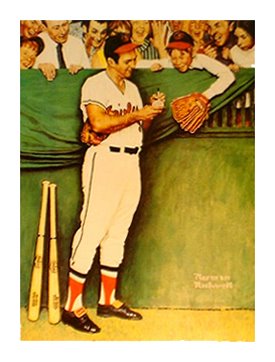
Thankfully, it wasn’t always this way in Baltimore. This month, the Maryland Science Center opened an exhibit of Norman Rockwell paintings in Baltimore that will run through January. The featured painting, “Gee Thanks, Brooks,” is the famous rendering of Brooks Robinson signing a baseball for a young fan. According to
The Sun article about the exhibit, it was the only solo portrait of a named baseball player ever painted by Rockwell.

Often criticized for illustrating an idealized America that never was, Rockwell didn’t have to stretch the truth much for “Gee Thanks, Brooks.” A Hall of Famer, Brooks was the genuine article then and still is today. The Orioles would do well to ask players to create more “Gee, Thanks” moments for fans than “Oh, Jeez” moments that have become commonplace. Incidentally, Brooks Robinson has his own blog where he talks about the Rockwell exhibit and other baseball-related topics.

Despite being depressed by more news of the Orioles' cheating ways, my CAP average – the ultra-scientific system that rates my abilities as a fan in the categories of Current Knowledge, Ardor, and Participation – has risen slightly. I’m now averaging .207. Hey, at least we took two out of three from the first place Mets. Wow.


Further reading:
Selections from The Sun -

Fan reaction to Grimsley and Segui (hint: CAP isn't the only disenchanted fan)

Peter Schmuck on the steroid controversy "hitting home"

Wednesday, June 14, 2006

Listening In Behind Enemy Lines

Learning something from Yankee broadcasts

By Christopher Heun

I am an Orioles fan living in New York City.

That might sound like a terrible misfortune – to be surrounded by Yankees fans on their home turf – but the truth is, they couldn’t care less about me; it’s the Red Sox they hate. When the Orioles visited Yankee Stadium last September, I sat in the upper deck, proudly wearing my O’s hat. I got no reaction. But the dude in the Red Sox hat and jersey who walked through? Entire sections of people booed and cursed him. And the Sox weren't even playing.

Earlier this month, when the Yankees visited Camden Yards, I decided to listen to the local broadcasts of the games on WCBS 880 AM. Listening to an opposing team’s announcers guarantees an honest appraisal of your side, and hearing what the Yankees flagship station in particular has to say is sort of like eavesdropping on the popular kids at school: you may not admit it, but you want their approval.

I made some notes of the more interesting comments by play-by-play man John Sterling and his sidekick, Suzyn Waldman. Before I get into it, a few words about them.

Sterling has just the right voice to call a game on the radio and an authoritative tone that suits the Yankees. His signature call after every New York victory, though, is an incredibly annoying attempt at a vibrato flourish that sounds instead like a cross between a choking victim and a broken lawnmower: “The Yankees win! Thuh-uh-uh-uh-uh-uh Yankees win!”

Waldman became just the second woman in Major League Baseball history (and first in about 40 years) to serve as a full-time color commentator when she joined Sterling in the booth last year. She has two decades of experience reporting on sports for WFAN radio in New York, but despite that, there’s plenty of vitriol directed her way on the Internet, much of it based on the opinion that she “doesn’t know the game.” (Imagine what they’d say if they knew
she grew up a Red Sox fan in Massachusetts.) She comes across as a brassy broad full of the usual anecdotes about the players.

What I like about the pair is that they aren’t afraid to call out Yankee mistakes, something you rarely hear from home team announcers, in Baltimore or anywhere else (though Joe Angel does an admirable job of toeing the line, particularly since he knows his former partner, Jon Miller, was run out of town by owner Peter Angelos for not cheerleading). Last Friday night, for example, when Derek Jeter was hit by a pitch, Sterling and Waldman noted, rightly, that he stands close to the plate and dives into pitches. Then, a few plays later, when he was thrown out at third to end the inning, they gently pointed out that Jeter had broken a cardinal rule: never make the third out at third base.

(Waldman then felt the need to turn the mistake into a compliment by adding that the heads-up defensive play that nailed him at third was “just the kind of play Jeter would make.” I wouldn’t be surprised one day to tune in to a play-by-play of Jeter walking across the Harlem River from Yankee Stadium to Manhattan.)

Such unabashed homerism should be expected, of course. My complaint about the Yankee broadcasts has to do with the overwhelming number of ads during the actual game. (This is, of course, how the Yankees afford their $200 million payrolls. The YES TV network raked in $44 million in ad revenue last year alone.) Much of the time Waldman’s sole duty seems to be merely reading commercials. In the top of the fourth of one game, I counted four ads read in-between the action – and that’s not counting sponsors for the first pitch of the game, the first Yankees run, the first Yankees home run, the grand slam inning, the 15th out, and any pitching change. Even the broadcast booth itself has a corporate tag. Waldman repeats every game that Hideki Matsui’s at-bats are brought to us by a Japanese restaurant, even though a wrist injury will keep him out of the lineup until at least August.

So, with that as context, this is what I overheard:


“In Baltimore, it’s always a threat to rain. In the summer it can rain almost every day.” Sterling. Saturday, June 3.

What? The weather that day (like most other days) was pretty much the same in New York City as in Baltimore: overcast and drizzling. The two cities are only 220 miles apart, but to hear some people tell it, you’d think they were on different planets. My personal favorite is when people who live in New York (or Connecticut or anywhere north of New Jersey) come to Maryland and think they’re “in the South,” confusing direction with a place.

“The Yanks have always hit – and won – here.” Sterling. Sunday, June 4.

He’s right. As annoying as it may be, the Yankees are 54-25 at Camden Yards since 1996. However, Sterling poured it on a little thick June 8 when the Yankees were back in the Bronx hosting the Red Sox.

Looking at the out of town scoreboard, he noted that the Orioles had drawn just 17,637 for their game with the Blue Jays after three consecutive sellouts over the weekend. This is not a direct quote, just a paraphrase, but he said something to the effect of, “They should be thankful when the Yankees come to town, it’s a sellout. That’s a chunk of change.” So is the Orioles’ share of the luxury tax that the Yankees and Red Sox pay. That’s enough. Yankee fans can stay home. Oriole fans don’t want their money, though Peter Angelos surely does.

“One of the things the Orioles are not good at is paying attention on the field and someone should have paid attention to their catcher.” Waldman, Saturday, June 3.

Context: Nobody bothered to cover second base as Johnny Damon attempted to steal in the sixth inning. Tejada ran over and speared the throw, saving the runner on third from scoring. This is what I was referring to when I said that listening to an opposing team’s announcers guarantees an honest appraisal of your side. Ouch.

“He’s not a savior, he’s a pitching coach. Give him some talent. He’s a good pitching coach.” Waldman. Sunday, June 4, talking about Leo Mazzone.

She mentioned that Daniel “Cabrera says, ‘I always walk people’” and reached the conclusion that Mazzone’s powers of influence were “blown out of proportion.” About Rodrigo Lopez, Sterling offered this gem: “He can throw what he wants. He’s a veteran.”

What? That’s just nonsense. Cabrera will never be more than “a big talent” – or whatever empty platitude you choose – until he stops walking a batter every inning. Lopez, who’s inconsistent at best, should be soaking up all the advice he can get.

“Perlozzo couldn’t believe [Corey] Patterson couldn’t bunt. They went one day and worked all morning in spring training and in that spring training game he got a hit with a bunt, and he’s got 10 or 11 of them this year.” Waldman.

She told this story twice over the weekend. It’s an interesting anecdote, because it’s the first I’ve heard of it. I don’t believe it’s ever been reported by The Sun.

When Patterson stole second and third base in the bottom of the seventh inning Sunday with the Orioles leading 10-4, igniting Larry Bowa into a rage, Sterling and Waldman said they really couldn’t blame Patterson for running. For the record, the very next night, with the Yankees leading the Red Sox 8-2 in the second inning, Alex Rodriguez stole second base.

No discussion of a Yankees series in Camden Yards would be complete without mentioning the amount of fans rooting for the visiting team:

“I talked to some people outside the stadium, ‘What, did you come down from Jersey?’ They said it’s easier to get tickets here. They can’t get tickets at The Stadium.” Waldman. Friday, June 2, in which she noted the throngs of Yankees fans dates back to 1996 and ‘97.

“A standing ovation for Randy Johnson in Camden Yards. Shows you how many Yankees fans are in this place. He’s even tipping his cap.” Waldman. Saturday, June 3.

During the top of the first on Sunday afternoon, Joe Angel on WBAL gave a long pause as Jeter came to the plate and the stands filled with cheers:

“Well, you hear the ovation like that, you wonder why Jeter isn’t wearing a home uniform. Last night Randy Johnson got a standing ovation as he left that game. They tell me in New York that he has not received that kind of ovation in Yankee Stadium this year.”

Angel imitated his Yankees counterpart at the end of the game with this:

“Yankees lose! Thuh-uh-uh-uh-uh-uh-uh Yankees lose! And the Orioles are in the win column here on this Sunday afternoon! They win the finale 11-4. Sunday dinner’s gonna taste real good. And we’ll be back with the lovely totals right after this.”

Lines like that are one reason why I’m an Orioles fan who lives in New York City and listens to Joe Angel over the Internet.

Tuesday, June 06, 2006

They're Playing Our Song (But Better) in Motown

Can Flanagan learn anything from the turnaround in Detroit?

By Christopher Heun

This may sound familiar to anyone who follows the O’s: a team with an eight-year losing streak gets off to a surprising fast start, sits comfortably in first place on Memorial Day and gives its fans big hopes for the playoffs.

This year, the Detroit Tigers are impersonating the 2005 Orioles so closely that they began the season with a hot-hitting infielder swatting home runs at a Ruthian pace – Chris Shelton in the role of Brian Roberts – and have just now endured an injury to a lefty starter – Mike Maroth as Erik Bedard.

Chances are, the Tigers will throw out the rest of the script rather than mimic the implosion that befell the Birds a year ago – the steroids, the finger-pointing among teammates, the drunken driving arrests, the piles of losses – but they probably won’t make the playoffs, either. More on that later. (Actually, see the next post).

The strongest similarity between the two clubs is how bad they’ve been for so long. Oriole fans like to think they have it tough, but anyone who roots for the Tigers has suffered even worse: Detroit hasn’t produced a winning season since 1993, four years longer than Baltimore, and they haven’t made the postseason in 20 years. Twenty years! We’re talking the days of Trammell to Whitaker to Evans.

Much of the coverage about Detroit this year has focused, rightly, on their pitching, which leads the league in ERA. That’s where the similarities end with the 2005 Orioles. These Tigers, with an impressive quartet of young starters, aren’t a flash in the pan.

So, if they have rebounded so quickly after losing 119 games in 2003 and 90 more each of the two seasons since, why can’t the Orioles manage that, too? Can Mike Flanagan learn something from his general manager counterpart, Dave Dombrowski?

I can’t believe I’m going to say this, but I don’t think so.

The Sun’s Peter Schmuck pointed out in a recent column that Dombrowski took a risk before last season when he signed the “chronically injured Magglio Ordonez to a huge contract that – even in the glow of the team's terrific start – still could come back and haunt the franchise.” That’s right. Although the five-year, $75 million deal included an injury clause that would let the Tigers off the hook if Ordonez suffered a repeat of his knee problems in 2005, there’s no such protection for the remaining four years.

But then Schmuck also wrote that “the important thing is, the Tigers were bold and now they are beautiful, though there is still a long, long way to go.”

Huh? What’s bold about giving $75 million to a gimpy slugger? Or giving a combined $39 million to Troy Percival, Todd Jones and Kenny Rogers, who are all over 35? Because that’s what Dombrowski has done the past two off-seasons. That’s not bold. That’s dumb. You can’t spend your way back to respectability. Exhibit A: Albert Belle.

Percival, 36, the former Angels closer, hasn’t pitched this year and only appeared in 26 games last year, recording eight saves. The Orioles thought about signing Jones, 38, but didn’t – thankfully. About Rogers, Ken Rosenthal wrote this: “A scout offered a succinct indictment of Rogers' two-year, $16 million deal, saying, "It's $8 million a year for a 41-year-old guy who throws 84 mph.”

The Tigers have an $82 million payroll this year, $10 million more than the Orioles. That doesn’t mean much, since Flanagan tried to throw Angelos Confederate bucks at the same players Dombrowski signed.

In Dombrowski’s defense, he has a track record for building champions from scratch (see: Marlins, 1997; and Marlins, 2003, two years after he left Florida but had put major pieces in place). He managed to assemble his current starting corps in Detroit with a combination of shrewd trades. He dealt for Jeremy Bonderman in 2002 (giving up Jeff Weaver, his best starter at the time), and Nate Robertson in 2003, then drafted Justin Verlander No. 2 overall two years ago. Mike Maroth, the other starter besides Rodgers, came to Detroit via trade under the reign of Dombrowski’s predecessor, Randy Smith.

Dombrowski also stole shortstop Carlos Guillen from Seattle in 2004 and picked up Shelton in the Rule V draft. And, he gets credit for attracting top scouts. “Dombrowski scored a major coup last month luring scouting director David Chadd away from Boston,” Peter Gammons wrote in November 2004. “Chadd is one of the game's best talent evaluators, and not only is he further empowered in Detroit, he was attracted by the loyalty that most Dombrowski employees feel toward their boss.”

You don’t hear that sort of praise about David Stockstill, the Orioles director of minor league operations, or Joe Jordan, the scouting director. Until recently, the Orioles' farm system was dry, but things are looking up: Baseball America ranked it 13th out of 30 last winter and the 2005 draft, the first headed by Jordan, “looks like it could be a monster,” Kevin Goldstein of Baseball Prospectus told The Sun.

For the record, when outfielder Nolan Reimold and pitcher Garrett Olson show up in Camden Yards, the credit goes to Jordan.

So, the point is, the Orioles are going about their business pretty much the same way as the Tigers: scouting out young talent and trying to complement it with a mix of veterans. Only the Orioles aren’t getting favorable results as quickly.

It’s not like winning baseball is a secret formula. “I think we have a quality club,” Dombrowski told the Washington Post last month. “Our starting pitching is very solid, which puts us in a position where we can compete on a daily basis, and we also have a very solid bullpen that allows us to shorten the game. There are just some shortcuts you can't take. Doing this takes time, and you just hope you don't run out of time before people's patience runs out.”

Undoubtedly, Flanagan and his assistant GM, Jim Duquette, would agree.

"In baseball, anything can happen, especially if you get good pitching," Duquette told The Sun before the season started. “The offense for the [world champion] White Sox was one of the worst [in runs scored] in the American League last year. The majority of the teams that get to the playoffs are the teams that pitch and play defense. That's why our focus has been on that direction.”

Right. Sounds good. Until you hear the rest of his quote:

“We do think our starting pitching is our strength."

That’s enough to make you wonder if the guys pulling the strings in the Warehouse really know which end is up.

News Flash: The Tigers Are Human

They won't make the playoffs unless they play Kansas City 25 more times

By Christopher Heun

The original title for this post was The Tigers Aren’t That Good, but that would be inaccurate. They are a good team, just not as good as their record.

As impressive as their 35-15 mark on Memorial Day may be, they very well could miss the playoffs. Like the 2005 O’s, their schedule for April and May was easy; only five wins came against teams with a winning record on May 29. They’ve won all of their eight games against Kansas City (14-41) but lost all three versus Chicago (34-22). (They split two games in Baltimore last month.)

Last week the Tigers started a stretch of 13 consecutive games against the Yankees, Red Sox, White Sox and Blue Jays. They lost five of the first seven heading into Tuesday night's game at Chicago.

As well as they’ve played the first two months, Detroit hasn’t run away with the AL Central. With a slim 2.5 game lead over the White Sox heading into their series tonight, the Tigers could slip to second place by next week. If they don’t win their division, they’ll have to win more games than the likely runner-up in the East, Boston or New York, to keep playing in October. What are the chances of that?

Manager Jim Leyland did his best to put his spin on losing before it even happened, like a politician on the Sunday morning chat shows, when he said this to Tom Verducci of Sports Illustrated before Memorial Day:

“I disagree with the people who say, ‘Now we’ll find out if they’re for real.’ We’re for real. Are we going to keep up with this torrid pace? No. People will think it’s because of the teams we play. No. We can’t keep up this torrid pace no matter who we play. But we’re legit. We’re not some fluke team.”


Memo to Jim Leyland: nice try, but you’re losing because you’re playing winning teams for a change. Of course, they’re also losing partly because Shelton, who had nine homers by April 17, has only hit two since and managed just three extra base hits in 64 at bats since May 14. (Against New York and Boston pitching he was hitless in 17 ABs). And the starting rotation, often cited as the team’s strength, endured its first injury Friday when Mike Maroth underwent arthroscopic surgery to remove bone chips in his left elbow. The Yankees bombed his replacement, Roman Colon.

The Yankees are another story. Despite running triage in their locker room, they keep winning. First Hideki Matsui is lost to injury, then Gary Sheffield. That doesn’t even count Carl Pavano, who hasn’t even played in a game yet this year, and Shawn Chacon, who will likely come off the 15-day DL later this week.

I’m tired of hearing how every contending team faces a test whenever it plays the Yankees. Crank up the hype machine, the team from the Bronx is in town. Why shouldn’t it have been the other way around, particularly for their series in Detroit, given that the Yankees opened with a lesser record, hobbled by injuries to Matsui; Sheffield, who missed three of the four games; and Johnny Damon and Derek Jeter, who both missed two (although replacing Jeter at short is a blessing in disguise, since he is truly below average defensively, one of the worst fielding shortstops in the game, as Baseball Musings proves.

Regardless, the Yankees came within two outs of a sweep, which should tell us something about their depth. Melky Cabrera has been hitting like Miguel Cabrera and Andy Phillips has turned heads too.

Monday, June 05, 2006

The Great Experiment, Week Eight: Who You Calling Superstitious?

If Tejada's bats are full of hits, can he share with everyone?

By Aaron Koos

One great aspect of baseball is the sport’s enduring indulgence in superstition, unexplainable phenomena, and general quirkiness. Today, Rodrigo Lopez told The Sun that his preference for being caught by Javy Lopez "could be superstition, whatever."

Lopez may try to minimize his statement by throwing in a nonchalant “whatever,” but after the Lopez-Lopez battery recorded their third win in a row Sunday, you can bet that Sam Perlozzo won’t dare break that streak of luck next time Rodrigo is scheduled to take the mound. Because, while all athletes usually profess to some superstitious behavior, baseball players’ collective obsession with luck and taboo approaches a level of mental illness.

I once knew a college baseball player who absolutely freaked out when I innocently picked up his game bat. I didn’t know the rule that “NOBODY TOUCHES THE BAT … EVER!” I thought he was kidding, until I was not so politely escorted out the door to keep him from taking batting practice on my skull. I can only imagine what sacred rituals were performed to remove the impurities I had inadvertently transferred to the bat.

You see, I didn’t understand that hits actually reside inside bats, and there is a finite number in each bat. This isn’t the theory of just one psycho, either. The belief is widespread and persistent, and Major League Baseball is Chock Full O’Nuts.

Struggling Kevin Millar was pinch-hitting on May 14 with the Orioles trailing the Royals with two outs in the ninth when his bat broke. Miguel Tejada tossed Millar one of Tejada’s own bats, with which Millar then proceeded to drive in the winning run. Millar later commented that the bat actually felt awful in his hands, but he still used it because it belonged to Tejada and therefore probably had some hits left in it.

Later, when Millar was relaying the story to reporters in the clubhouse, he motioned to Tejada that he still had the bat, but wasn’t in any hurry to give it back. Apparently, Tejada smiled and gave the thumbs up sign, but I doubt he was in any hurry to claim it back either, given Millar’s string of luck – or lack of it. It would probably take a voodoo high priest and truckload of mojo to restore the bat to Tejada’s liking.

There are hundreds of great stories about baseball superstition, from curses involving Bambinos and Billy Goats, to rituals you can see every night in every park around the country, like players hopping over the foul line or donning rally caps.

The personal superstitions of individual players are the best. Wade Boggs is one of the most notorious worshippers of Lady Luck, religiously eating fried chicken before each game of his 18-season long career, but he had a whole litany of ritualistic, bizarre habits that you can read about here.

Here's a sample:
During night games, Boggs stepped into the batting cage at 5:17 and ran wind sprints at exactly 7:17. (Once, in Toronto, a devious scoreboard technician changed the clock from 7:16 to 7:18. Boggs reportedly threw up.)

I don’t know what it is about Boston, but Fenway Park seems to be at the epicenter of baseball’s Twilight Zone. On a visit there several years ago, I realized that Nomar Garciaparra is one obsessive compulsive dude. The day I was watching him I noticed that he was constantly twitching, hopping, wiping, and tapping while he was in the field – like he was being eaten alive by mosquitoes. I don’t think he was relaying signs either, unless they were from extraterrestrials.

At first I thought he was just keeping loose, but as the innings wore on, I realized I was watching a superstitious obsessive-compulsive disorder ritual that he carried out before every single pitch. It was so involved that he didn’t even slide his glove on until the split second before the pitcher released the ball. It was nerve wracking to watch. It’s not something you normally pick up about Nomar in TV coverage, and I’ve never really heard it widely discussed. Is this well known? Whatever he’s doing now, though, he should probably continue; he’s currently hitting .369 for the Dodgers … knock on wood.

If you have a favorite baseball superstition or quirk, please post a comment to this blog – especially any Orioles-specific oddities. We’d love to hear about them, or about any lucky charms or rituals you use as a fan. However, if you are currently “helping” the O’s (sub-.500, fourth place, 8.5 games back), you might want to consider either switching up your routine, or doubling your efforts. Whatever. (As Rodrigo would say.)

Oh, as for my CAP rating – the ultra-scientific system that rates my abilities as a fan in the categories of Current Knowledge, Ardor, and Participation – it dropped significantly these past two weeks. Just as I predicted, exciting season finales during May sweeps, and a long, often un-televised West Coast road trip just about drove me away. I’m only averaging a dismal .097, and if I don’t watch out I’ll be designated for assignment soon.

Luckily, I’ve got this blog to keep me involved.

Friday, May 26, 2006

Who's the Most Oriole of Them All?

A pennant race away from a top spot, Mora climbs the ranks of team history

By Christopher Heun

When you think of the Orioles franchise – not this year’s team, much of which is probably better left forgotten, but all the players over the last 53 seasons – which names come to mind?

Probably Cal and Brooks, Eddie and Boog. Those guys, along with Mark Belanger, have played the most games in an Orioles uniform. It’s no surprise, then, that we’re on a first-name basis with them. Same for Brady, No. 6 on the list.

Now that Melvin Mora, the longest-tenured current Oriole who ranks No. 25 in games played in Baltimore, has finally been signed to a three-year contract for $25 million, it’s time we start considering him as a face of the franchise. Because by the end of this season, assuming he plays in 100 of the 114 remaining games, he’ll finish with about 860 under his belt and move up seven places on the list, just past Doug DeCinces and behind Mike Devereaux.

At that point, he will need 386 games to pass Rick Dempsey for No. 10, which averages out to just less than 130 games every season. It would mean that only nine other players will have appeared in more games in their Orioles career.

The next guy on the list after Dempsey is Al Bumbry, at 1,428. Mora could conceivably pass him, too, if he came back for a fourth season, the option year of the contract, and played every day.

That’s heady territory, among the top rungs in team lore. This is what’s been missing in all the talk about the new contract: the fact that Mora has a chance to finish his career as one of the team’s most treasured players, his name uttered in the same breath as guys like Dempsey and Bumbry and Ken Singleton. Sure, he’s no Brooks or Boog, but you’ve got to love the guy for reasons I’ve already chronicled.

And granted, simply playing in a lot of games is not the same as hitting home runs in a pennant race, but the statistic is a useful substitute for the other, more interesting offensive numbers. Mora would not have played so much if he hadn’t been producing. In fact, his career totals for homers, RBIs and runs scored rank roughly the same as his games played. (He's 11th in AVG, 13th in R, 17th in RBI and 19th in HR)

Recently, Mora’s place in team history has been overshadowed by a deluge of fans frustrated that the front office seemed willing to let him follow B.J. Ryan out the door to free agency, as well as the debate, most vocal in the blogosphere, about the wisdom of a three-year deal for a player who will be 37 in the final season of the contract.

[About that I will say this: The season he turned 41, with his skills obviously diminished, Cal Ripken Jr. made $6.3 million, third-most on the club. Of course, he is a special case, a legend not just for the team but the entire sport. However, it points to a larger question of what each home run and extra point of batting average is “worth” on the open market. Alex Rodriguez made $48 million the last two seasons, nearly $42 million more than Mora, and produced an extra 11 hits, 30 homers and 44 RBI. Is that worth it? For that matter, is Mora worth $900,000 less than David Bell or four times more than Hank Blalock?]

What’s most gratifying about his contract is that the Orioles actually have a nucleus of everyday players worth keeping and the front office has acted, however slowly, to retain them. Mora, Miguel Tejada, Brian Roberts, Ramon Hernandez, and Jay Gibbons are all signed through 2009.

On the mound, Erik Bedard, Daniel Cabrera and Chris Ray are signed for three more years with Kris Benson around for 2007 and an option year.

Youngsters like Nick Markakis and Sendy Rleal look like they’re going to develop into quality players. Those two, along with Gibbons, Roberts, Bedard, Cabrera, and Ray, have never worn a major league uniform other than the Orange and Black. Nothing looks better than home-grown talent.

Gibbons (650 games) and Roberts (552 games) made their Orioles debuts in 2001, a year after Mora, and aren’t that far behind him on the team’s all-time games played list. Because they are both younger than 30, they’ve got a chance to wind up even higher.

What they need to really earn their stripes in Orioles history is a winning season, a pennant race that teases fans and makes heroes out of players. Rick Dempsey wouldn’t bring half as big a smile to our faces without the 1983 World Series. The nail-biting "Why Not?" season of 1989 made a household name out of Mike Devereaux – remember the homer he curled around the Memorial Stadium foul pole?

This current group of O’s will get a chance in the next three years to create their own magic. After all the losing they’ve been through, it will be so much sweeter when they finally do.

The Top 20 list of games played for the Baltimore Orioles, in case you’re wondering:

Cal Ripken 3,001
Brooks Robinson 2,896
Mark Belanger 1,962
Eddie Murray 1,884
Boog Powell 1,763
Brady Anderson 1,759
Paul Blair 1,700
Ken Singleton 1,446
Al Bumbry 1,428
Rick Dempsey 1,245
Rich Dauer 1,140
B.J. Surhoff 1,001
Rafael Palmiero 1,000
Davey Johnson 995
Gus Triandos 953
Chris Hoiles 894
Mike Devereaux 878
Doug DeCinces 858
Gary Roenicke 850
Frank Robinson 827

The complete list, including players dating back to the St. Louis Browns, can be found here.

Wednesday, May 24, 2006

A Tale of Two Cities ... And Other Cheap Cliches

Lessons learned on my trips up and down I-95 for evenings at the ballparks.

By Matthew Taylor

I had baseball bookends propping up my work week last week. On what turned out to be “just another manic Monday” at Camden Yards on May 15 I watched Boston’s depressing 11-1 victory over the O’s. Days later I was “getting wild all around Friday night” with Brent, a longtime friend and fellow Birds fan, as the Orange and Black took their first and only game from the Nationals at RFK Stadium. My attendance at each game forced me to violate two of my cherished, albethey fleeting, personal rules. But I learned some things along the way, so it wasn’t a total loss.

On Monday I violated my “Don’t attend a Yankees or Red Sox game at Camden Yards because the out-of-town fans will just annoy you” rule. I instituted an earlier form of this rule in the late-‘90s just for Yankee games. The rule caused me to miss the end of Cal’s consecutive games streak, and the start of the Ryan Minor era (see “Where Have You Gone, Chris Richard?” posting), on a night when I had tickets to the game, but that’s like saying I missed “Saved by the Bell: The New Class” even though I had NBC.

I extended this personal rule to include the Red Sox two seasons ago after Chris, my longtime friend and short-time co-blogger (did I really just use the term “co-blogger”?), turned out to be right with his playoff proclamation that Red Sox fans would be just like Yankee fans if they won a World Series. Here I was doing carpet angels – a domestic version of the popular outdoor winter activity – after Boston took down the Yanks in the 2004 ALCS with no clue of what the victory really meant to O’s fans. We now had two annoying A.L. East rivals to deal with: the Evil Empire and a slightly less annoying, Mini-Me version of the same.

On Friday I violated a second personal rule, this one being my public “Don’t get caught up in the ‘Battle of the Beltway’ hype” decree that appeared in the May 4 posting “A Rivalry of Minor Concern.” As you can see, I’m about as disciplined with this stuff as Rick Sutcliffe is in a San Diego Padres broadcast booth.

In my own defense, I did tell a local Fox reporter during an on-camera interview on Friday that the O’s-Nats rivalry was a media creation. (RFK was crawling with journalists who were all after the same non-story.) In addition, the tickets to the game were free thanks to the generosity of Brent, another longtime friend, though not a blogger. Nevertheless, I was still there among the 30,320 “strong” at RFK, so the kettle can now rightly call me black in return.

I don’t fancy myself interesting or self-important enough to do a running diary of last week’s games, a la ESPN Page Two’s Bill Simmons, but I will gladly share some of my lessons learned from those trips to the ballpark. Perhaps I’ll even develop a new short-lived personal rule along the way.


-Lesson No. 1: It’s more fun to be a fan of a visiting team than it is to be a fan of the home team.

Baseball logic, reinforced by the seventh-inning musical mainstay “Take Me Out to the Ballgame,” dictates that you always “Root, root, root for the home team.” It’s no secret, though, that when our O’s face off against either one of their division neighbors from the Northeast, there are more fans cheering for the A.L. East’s Evil Empires than there are root, root, rooting for the home team. But let’s not throw the baseball baby out with the bathwater.

If we Baltimoreans were to insist that our seventh-inning stretch entertainment make sense there’d be no room for “Thank God I’m a Country Boy.” And we don’t want to make John Denver rock ‘n roll over in his grave. Besides, “Take Me Out to the Ballgame” is still on the mark when it notes, “If they don’t win it’s a shame.” We O’s fans know that sentiment all too well.

There are many reasons that it’s more fun to be in an opponent’s ballpark, starting with the fact that you don’t have to defend your home turf. I was so stressed about Yankee fans at Camden Yards during the late-‘90s that I actually had a late-season nightmare about Daryl Strawberry – he of what I believe is still the longest homerun in the stadium’s history, a shot to straightaway center off of Mike Mussina – giving a curtain call in our ballpark. Yes, I had nightmares.

Just when I thought things were getting better UnderArmour came along and started promoting the whole “We Must Protect This House” slogan. Like I wasn’t feeling enough pressure already!

Nats fans were clearly feeling the pressure at RFK on Friday night, booing after a rousing “O” went up during the national anthem, countering spirited chants of “Let’s Go O’s” with their own “Let’s Go Nats” efforts, and even jeering the “Fan of the Game,” who sported an Orioles cap with his Nationals windbreaker.

On the downside, the hometown fans booed a little girl who sported a pink Orioles shirt and was also among the contenders for “Fan of the Game.” There are limits. Overall, though, it was a respectful effort by the organization and the fans to defend their turf, suggesting the friendly nature of this non-rivalry.

Other advantages of being a visiting fan include:

(1) You get to watch your own team take batting practice before the game. Friday’s BP at RFK allowed me my first opportunity to watch Melvin Mora take his pre-game cuts, driving a mix of line drives and opposite-field homeruns at will. He’s as intriguing to watch during BP as the sluggers, who are more typically pre-game fan favorites.

(2) You share an automatic connection with other visiting fans at the game, which leads to genuine enthusiasm for the O’s. Believe it or not, there were actual O’s cheers without any scoreboard prompting, which produced a vocal minority in RFK. After Monday I was pretty sure that I was among a dying breed of O’s fans. By the end of the week I once again had reason to “Believe.” Martin O’Malley would be proud.

(3) The attendance figures that pop up on the scoreboard aren’t as depressing when you’re away from home. Having been to the first Orioles game at Camden Yards, an April 3, 1992, exhibition match-up with the Mets, and proudly struggled to find tickets when my college friends visited town in the early-‘90s, it continues to be truly disheartening to watch the crowds diminish in size over the years and often change colors to support visiting teams. If you’ll forgive a metaphor that gives baseball much more import than it deserves, it’s sort of like watching the slow decline of a beloved aging relative. You still love them all the same, and in some ways appreciate them even more, but the visible signs of decline weigh heavy on your heart.

(There’s much more that could be – and indeed has been – written about the Orioles’ home attendance figures. For example, Peter Schmuck has a humorous, if depressing, take on the empty seats at the Yard. Tom Boswell also takes on the topic of attendance bottoming out and references the tendency for Red Sox and Yankee fans to take over Camden Yards.

The Birds’ overall attendance ranking among major-league teams continues its six-year slide and the team is threatening this year to hit its Camden Yards nadir for empty seats. The bottom line is that it was just downright sad to sit among so many Red Sox fans at the Yard last Monday and realize that O’s fans were simply doing the logical thing by staying home. Who can blame even the most devoted fans for refusing to shell out big bucks for an overly consistent, sub-.500 baseball team? I did wonder, however, why any free agent would want to play in a town where he’d be a visitor in his own ballpark for 16 games a season?

For an interesting look at attendance figures generally, follow the lead of The Sun’s Rick Maese and read this article on how the numbers are generated … and often exaggerated.)

(4) Did I mention that the O’s won in D.C. but lost at home?


-Lesson #2: Not all anger is bad.

I’m a recovering angry fan, the type of otherwise composed individual who loses all sense of reason and reacts in completely irrational ways while watching the home team struggle. I’ve stomped on hats, kicked furniture, and once even grabbed the collar of a Yankee fan who had the nerve during the ’96 playoffs to proclaim, “Orioles Suck!” All angry acts in the name of fandom that produced negative results. But I learned on Monday night that restrained angry thoughts, rather than demonstrative actions, can actually produce positive results.

Having shown Jobian patience – and stayed for all nine torturous innings – as the Red Sox dismantled the Orioles before a partisan Boston crowd at Camden yards, I daydreamed upon my exit about how nice it would feel to toss trash at the young fans in my section who were a living, breathing, making-out at the ballpark version of the Boston Teens couple, played by Jimmy Fallon-Rachel Dratch, on “Saturday Night Live.” Instead of carrying out my plan and seeming like a lunatic, I came across as the thoughtful friend when, during my scan for appropriate articles of trash, I located the Ravens backpack under the seats that my buddy was about to leave behind. Score one for restraint!

By the way, have I really referenced aging relatives and the Bible in the same posting about the Orioles? Somebody stop me before I start taking this stuff too seriously.


-Lesson #3: Springtime baseball games are cold.

Fool me once, shame on you. Fool me twice, I’ll buy a cheap Orioles baseball shirt from a street vendor outside RFK.

On Monday night I mistakenly changed into shorts prior to my short drive up 95 to Camden Yards. More accustomed to humid Baltimore summer evenings at the ballpark than inconsistent Spring nights there, I changed my tune if not my pitch by Friday, sporting jeans and a t-shirt on my longer trip down 95 to D.C. The cool wind that welcomed me to the Nation’s Capitol whispered – or perhaps “Roar”ed? – to me that I still wasn’t adequately prepared for an evening of baseball.

Several minutes later, as I showed off the three-quarter length sleeves on my new $15 baseball shirt, that aforementioned Fox TV reporter approached: “I see you guys are sporting your Orioles gear for the game …”

Monday, May 22, 2006

The Great Experiment, Week Six: When Bad Friends Keep Calling

Maybe what this relationship needs is some time apart

By Aaron Koos

Relationship experts will tell you that there are basically two types of friends. Hanging out with the good kind of friend leaves you energized and fulfilled. But the bad kind of friend just sucks the life right out of you. The 2006 Orioles definitely fall into the latter category.

You know the type. Bad news all the time, constantly asking you to help them move. After a while, with friends like the O's, you sort of hope they just stop calling until they get their act together.

Thankfully, that is exactly what is going to happen with the Orioles this week. They're three time zones away, and the entire O's-Mariners series won't even be televised. Of course, you could tune in to the WBAL radio broadcast, which begins at 10:05 p.m. ET. You could also call your buddy who just got dumped and ask him to recount his break-up until 1 a.m.

My guess is that you're going to do what most casual fans will do: take the week off. But don't feel bad about it. With coverage like this, clearly this is not a team or a sport that cares about keeping fans.

Though don't write them off entirely - not yet at least. Maybe you just need a break, and so do the Orioles. A little distance this week might be good for everyone.

After all, they're only 6.5 games back, and four games under .500. These are hardly insurmountable odds, especially given that their opponents this week, the Mariners (20-25) and Angels (17-27), are also struggling. The Orioles are starting the four-game series in Seattle with their two best pitchers, Bedard and Benson, with the first start of the season by the club's top prospect, Hayden Penn, sandwiched in-between. Brian Roberts could be back from the DL. This could get interesting.

Isn't that always the way with bad friends, though? There's always the hope that they'll turn things around and everything will get back to the way it used to be. Remember the good times you shared?

Taking a week off as an O's fan certainly isn't going to help my CAP average, the system that rates my fan activities in the categories of Current knowledge, Ardor, and Participation. But, it can't get much worse, either. Last week after taking the advice of my fellow blogger Matthew Taylor not to buy into the over-hyped rivalry between the O's and Nats, I didn't see even one interleague game. Maybe I misinterpreted Mr. Taylor's blog posting, but nevertheless, my average fell. I'm now only hitting .172 as a fan.

Tune in next week to see what happens to a CAP average after a week where five of seven games start after 10 p.m., three straight games aren't even on TV, the Baltimore weather forecast is mostly sunny with temperatures in the seventies, and both “Lost” and “American Idol” wind up their seasons. Watching a replay of poor Barbaro at Preakness might be less ghastly.

Friday, May 19, 2006

Taking Stock of the First 40 Games

How much longer before Hayden Penn cracks the starting rotation?

By Christopher Heun

The first quarter of the 2006 season is over. These are the facts:
The Orioles are 19-22 heading into Friday night’s game against the Nationals in D.C.

They’re in fourth place, 5.5 games behind first-place Boston and two games out of the basement.

The pitching staff has given up more runs and more walks than any other team in the American League.

Hayden Penn has a 1.48 ERA in five starts at Triple A Ottawa. In 30 innings, he’s struck out 29, walked 11 and given up 21 hits.

But the most revealing stat of all is this: Of the first 41 games, Brian Roberts and Javy Lopez played in just 24 of them. Reliever Sendy Rleal appeared in more. The Orioles were 6-10 without Roberts. Lopez was also missing from the lineup for most of that stretch.
There’s no question injuries and inept starting pitching – of the rotation, only Bedard and Benson have ERAs under five – have been the biggest problems. And as glaring as they are, the good news is that the team finished the first 41 games only 3 games under .500.

The injury bug started April 29, when Roberts went down with a groin pull. In the top of the ninth that day, catcher Ramon Hernandez was forced to play first base, Melvin Mora moved to second, Chris Gomez was at shortstop and Jeff Conine had to dust off his third baseman’s mitt. Raul Chavez was behind the plate. Miguel Tejada and Lopez were in the trainer’s room. All that was missing from the makeshift infield was Lenn Sakata wearing a catcher's mask.

Because of injuries, on May 10 the starting infield, from first to third, was Conine, Brandon Fahey, Tejada and Chris Gomez after Mora injured his back the night before. Some players believe the team is snake-bit.

"It just seems like every year, there's been something," Jay Gibbons told The Sun. "It's kind of disheartening. Look at the team we ran out [May 10] compared to Opening Day. It's not even close. We can't afford to lose guys. We've got some guys that are still learning the game and it's hard to compete that way."

The pitching staff has not escaped injury either. Daniel Cabrera went on the disabled list this week, but his lack of command so far this season shouldn’t be blamed on a stiff shoulder, Sam Perlozzo says.

The bullpen has been a mess; that’s well documented. Kurt Birkins, Julio Manon, Chris Britton, Eddy Rodriguez – none of whom were on the Opening Day roster – have all appeared in at least five games.

The biggest puzzler of all, though, has been the starting rotation. Even if you didn’t believe that Leo Mazzone, with all his success in Atlanta, was just going to snap his fingers and lower every Orioles pitcher’s ERA by a run, you still have to be surprised by how bad they’ve been.

The team ERA is second worst in the league, behind Kansas City (who’s only won 10 games all year, an indication of how bad the O’s record really could be). And the staff is tied for the second-most number of homers allowed.

The Washington Post’s Dave Sheinin had this to say during an online chat May 9: "When I talked to Mazzone about this a week or so ago, he expressed some frustration at how the Orioles' pitchers had not yet completely bought into his mantra of pounding fastballs away, away, away. I suspect it is something that will take some time – perhaps even a full season – to sink in."

The other key bit of advice Mazzone has for his pitchers is to throw more than usual between starts, which some people consider unorthodox. Perlozzo defended that in an interview with The Sun: "Hitters go out and they hit every day," he said. "Fielders take extra ground balls. It only makes sense that the more you work on a pitch, the better it should get."

Perlozzo doesn’t really have much choice but to bump Rodrigo Lopez (7.86 ERA) and Bruce Chen (8.23 ERA) from the rotation. Lopez pitched well in the bullpen in 2004, even if he was vocal about his unhappiness with the role. "I think eventually you'll come to a time where you're going to have to say, 'That's it, guys, jobs are in jeopardy,'" Perlozzo told The Sun.

Meanwhile, Penn will likely get called up next week to make at least one start in place of Cabrera. How long he’ll stick around is the question.

In the month of May, an Orioles starter has pitched seven innings only three times: Cabrera, Benson and Bedard each managed it once. That’s a lot of innings for the bullpen.

At the 20 game mark, I said the pitching would get better, for the simple reason that it had to. I was wrong – so far, anyway. The team ERA actually got worse since then, slipping from 5.44 to 5.64. But I still say it gets better.

About his recent slump, Kevin Millar had this to say in his online journal at mlb.com: "I also understand that there's a lot of baseball left and a lot of at-bats left. And that's why they call it a [batting] average."

The same applies to the pitching staff’s earned-run average. Let’s hope they both improve.

Thursday, May 18, 2006

Three Hurlers Who Bear a Grudge

Why it's probably better that Sidney Ponson is in the NL

By Christopher Heun

Last week’s "Where Are They Now?" feature was consumed with young players who never delivered for Baltimore or anyone else. There’s also another interesting group of former Orioles, a trio of starting pitchers who must bear a grudge, judging by their performance.

Two of the three, Jason Johnson and Josh Towers, are marginal major leaguers who pitch better against their former team than against anyone else. The third, ageless wonder Jamie Moyer, beats the O’s and the rest of the American League with a regularity that was unknown to him more than a decade ago when he wore the Orange and Black.

Johnson never won more than 10 games in a season for the Orioles despite being a mainstay of the starting rotation from 1999 to 2003. In fact, only two other pitchers – Livan Hernandez and Jeff Weaver – have lost more games since 2000 than Johnson, who is 44-76. (Sidney Ponson is tied for 7th on that list, with a 59-70 record.)

Since leaving Baltimore, in two years with Detroit and now Cleveland, Johnson is 18-31 with a 4.89 ERA. But versus the O’s, he takes on a different identity. He’s 4-1 with a 3.48 ERA including a win at Camden Yards April 18, when he went seven innings and gave up just one earned run.

Soft-tossing Towers was drafted by the Orioles in 1996, came up through the minor league system and was a pleasant surprise in 2001, going 8-10 with a 4.49 ERA for a team that lost 98 games. But he didn’t last long the following year and eventually was released and signed with Toronto. If he was still in Baltimore, he might have some tips for Daniel Cabrera: Towers walked just 29 hitters last year in 208 innings. (Towers had 21 walks in 167 innings with the Orioles; Cabrera walked 89 batters in 147 innings in 2004 and 87 batters in 161 innings last year.)

Despite a record-breaking rough beginning to 2006 – Towers lost his first seven starts of the season and racked up an ERA over 10, which had never been done before, according to the Elias Sports Bureau – he still has a winning career record post-Baltimore: 31-29 with a 4.63 ERA. But against the O’s he’s an uncharacteristic 5-2 with a 3.38 ERA in nine starts.

He managed to break his streak this year without seeing the Orioles. He beat Tampa Bay last week.

Which brings us to Moyer, 43, who made his debut in 1986 when Josh Towers was 9 years old. He bounced around the majors for a decade, playing with five different teams, including the Orioles from 1993 to ’95, before landing in Seattle, where his career has taken off. In fact, you could argue he’s the best pitcher in Mariners history, surpassing even Randy Johnson.

Before Seattle, he’d had only two seasons with an earned run average of less than four and he’d reached double digits in wins just three times. With the Mariners, it’s been just the opposite: he’s never won less than 13 games (with one exception), twice he’s won 20, and six out of the nine years his ERA was less than four.

His 140-78 mark with the Mariners gives him the franchise record for wins (10 more than Johnson) and also the second-most losses, behind Mike Moore. Moyer also holds the team record for innings pitched, games started and homers allowed. Only the Big Unit has struck out more batters while wearing a Mariners uniform.

In his career, Moyer is 17-3 with a 2.99 ERA versus the O’s. He beat them at Camden Yards April 30 and will probably get another shot at them next week when they visit Safeco Field for four games.

Monday, May 15, 2006

The Great Experiment, Week Five: A Dose of Ambiorix and Blind Optimism

Prescription for Fan Happiness

By Aaron Koos

Give The Sun some credit for trying to get an Orioles bandwagon rolling.

On the front cover of Monday’s print edition, right at the top, was a photo of Kevin Millar next to the teaser headline “AN IMPROBABLE RALLY.” Then, when you open up to the sports section — again in all caps and in a font size usually reserved for declarations of war — was the headline “
ORIOLES WIN WILD ONE” above a half-page photo of Javy Lopez crashing into home plate with the winning run.

When I first saw the coverage, I thought I’d missed something. Was there reason to celebrate? Should I dust off my “How ‘bout dem O’s?” greeting and reserve my curbside seat for the parade?

Reading The Sun, you might suspect that the Orioles aren’t a fourth-place, sub-.500 team that beat the last-place, 10-25 Kansas City Royals in front of a meager home crowd.

Sure, come-from-behind wins and series sweeps are great, no matter the circumstances. I actually tuned in yesterday and saw the comeback. And, while I was pleased, I’m not sure I saw anything improbable or wild, let alone IMPROBABLE or WILD. So, unless The Sun’s Caps Lock key is stuck, I’m guessing they’re motivated by something other than the O’s performance on the field to whip up some frenzy around this team. Could it be that The Sun hopes a few feel good stories might help move some more subscriptions?

They do need to sell more papers. Last week The Sun reported that
daily circulation has slipped 3.3 percent and Sunday circulation has fallen 6.6 percent. That’s not good news, especially for a newspaper that is facing stiff new competition. A new print daily, the Baltimore Examiner, just launched in April. It’s free and delivered daily, and is designed to be read in a schedule-friendly 20 minutes. According to an Examiner editor that I met at Camden Yards last week (at a non-baseball related event, lest you think I was actually motivated enough to attend a game), this is the first new daily paper to start completely from scratch since USA Today in 1982, and it's being extremely well received by readers and advertisers alike.

The Sun can’t be happy about the new competition, or the declining circulation, or trying to sell the same tired coverage about the same fourth-place, losing team. That’s why they’re selling stories about WILD nights at Camden Yards (there’s a joke that I’m not allowed to make here, due to the “who we are not” rules of this site).

True to its no-nonsense style, the Examiner didn’t break out the orange and black pompoms with their headline today: “
Orioles Score 4 in 9th to nip Royals,” although their article also characterized the game as “wild.”

I do realize that both papers were using “wild” as a reference to the sixteen walks issued in the game. Interesting though that they chose not to characterize this play as “sloppy” or “baffling.”

I guess you’ve got to accentuate the positive when you’re trying to attract readers. We’re not above this at Roar from 34. Let’s give it a try:

Isn’t it IMPROBABLE that Royals Manager Buddy Bell let KC reliever Ambiorix Burgos load the bases in the ninth with three consecutive walks and no outs in a four run game, and the Orioles didn’t find a way to squander the opportunity that was handed to them on a silver platter?

Isn’t it WILD that the Orioles are only 4.5 games back despite an 18-20 record, a string of bad luck injuries and a badly slumping free-agent first baseman brought in to do the opposite of what he’s been doing?

Wow. I feel better already. Let’s just ignore the losses and celebrate the wins. If you remember, that’s what Ravens coach Brian Billick did last season after a 1-2 start. When the previously winless Ravens finally beat the struggling Jets in game three, Billick inanely declared “We’re 1-0.” It should be noted that his first off-field job in the NFL was in the 49ers PR department.

When it comes to this week’s CAP score (the ultra-scientific formula that rates my fan activity in the categories of Current Knowledge, Ardor, and Participation), I’m taking my cue from the winning mindset of the Sun and Brian Billick. Rather than dwell on the details of my poor composite CAP average of .185 this week, let’s just point out that I actually tuned in for TWO comeback wins against Detroit and Kansas City. And, I now know that Ambiorix is not a prescription drug.

This could work. We’re 18-0! How ‘bout dem O’s, hon?

Tuesday, May 09, 2006

Where Have You Gone, Chris Richard?

From Jerry Hairston to Ryan Minor (and even the party-loving Sidney Ponson), a look at where all those might-have-beens ended up

By Christopher Heun


(note: photo taken from Webshots gallery of an Aruban Spring Breaker
)

Last week’s post about the unusual twists of Todd Williams’ career uncovered a few forgotten Orioles in Oklahoma City, the Triple-A affiliate of the Rangers. That was all the encouragement we needed to indulge in a little nostalgia about what might have been for some future stars who fizzled.


Remember when young guys like Chris Richard, Jerry Hairston, Larry Bigbie, Matt Riley and even Ryan Minor were supposed to carry the Orioles back to respectability? Whatever happened to those guys? Not a lot. Otherwise it wouldn’t take so much digging to find out where they are.

This may be the Curt Schilling Effect, in which the front office is so afraid of losing home-grown talent that they hold on to every player long past the point of his effectiveness and thus get nothing of value in return once they finally do decide to let him go.
Regardless, the most fun of "Where Are They Now?" stories is to dig way back into the closet of unfulfilled promise and shake the cobwebs off a few guys who not long ago generated high hopes in Baltimore, if not much more.

Chris Richard
was an everyday player in 2001, hitting .265 with 15 homers. But he could never duplicate that and is now playing first base part-time for the Triple-A Indianapolis Indians, his batting average just .158. The Orioles traded him in 2003 to Colorado, where he got just 27 at bats. He hasn’t appeared in a big-league game since.

Jerry Hairston
is still with the Cubs, who gladly dumped Sammy Sosa in exchange. Hairston is playing part-time and not hitting much. Last year he played more games in center field than at second base.

Larry Bigbie was awful last year in Colorado, where he hit just .212 after getting traded (for Eric Byrnes, who was even worse with the bat for the O’s but somehow managed to convince the Diamondbacks to sign him for $2.25 million last winter; he’s playing centerfield and hitting close to .300 so far this year). Bigbie, a former first-round draft pick, signed with the Cardinals in the off-season and was just activated off the disabled list Monday.

Last week, Matt Riley, who was awful in a short stint with the Rangers in 2005, tore a ligament in his pitching elbow while recuperating from the same injury that required surgery last summer. His career could be over. Rangers manager Buck Showalter told the Dallas Star-Telegram, “It's sad. Three days ago, he was throwing 94 mph. Now he's contemplating what he's going to do with the rest of his life.”

Rick Bauer
is also in Texas. In fact, he was the winning pitcher last Wednesday when the Rangers beat the O’s, 2-1, in 12 innings. He’s pitched fairly well in relief this year, with a 3.24 ERA in 16 and two-thirds innings. But he had worn out his welcome in Baltimore, never accepting a demotion gracefully.

One of his teammates in Texas is
Gary Matthews, Jr. He has never hit like his dad, though his bat has gotten warmer while with the Rangers the past couple seasons, which may be compliments of the ballpark in Arlington. Though his average slipped to .255 last year, he hit 17 homers, something he never came close to doing for the Orioles despite often hitting in the middle of the order.

Then there is
Ryan Minor, the man who replaced Cal Ripken, Jr., when the Iron Man’s consecutive games played streak ended, on September, 20, 1998. Minor was traded to Montreal for Jorge Julio in 2000, was released by two teams, played in the independent Atlantic League for parts of four seasons and is now a coach there. His major league career totals: a .177 batting average, five homers and 27 RBI in 142 games.

The former basketball and baseball star at Oklahoma was drafted professionally in both sports. Concentrating on baseball alone after being cut by the Philadelphia 76ers and spending a year in the CBA, Minor was the organization's player of the year in 1997.

Jack Cust, the guy who Chris Richard was eventually traded for, was named Player of the Week in the Pacific Coast League last week. He batted .615 (8 for 13) with three home runs, nine RBIs, nine runs scored, 11 walks and a Ruthian 1.385 slugging percentage for San Diego’s Triple-A team in Portland. At one point he reached base safely in 20 of 23 plate appearances and led the league in walks and runs scored and ranked second in on-base percentage.

A career .220 hitter with 58 strikeouts in 141 at-bats, Cust is probably most remembered for his inexplicable flop while barreling toward home in an extra-inning game against the Yankees. Baseball Analysts gives a first-person account of the night Cust tripped 10 feet from home plate, where no one was covering after a botched run-down. He hasn’t appeared in the big leagues since his lone at-bat in 2004 with the O’s.

Jose Leon is another ex-Oriole who’s ripping it up. The man who got 209 at-bats with the Orioles between 2002 and 2004 but never did much with them is hitting .358 with 14 homers and 36 RBI in 134 at bats with Piratas de Campeche in the Mexican League.

While it may be too soon to evaluate the Kris Benson trade, which sent
John Maine and Jorge Julio to the Mets last winter, there’s no denying that Maine was trumped up as a possible member of the starting rotation in Baltimore. This despite walking more than he struck out and pitching awfully in an audition that amounted to nine starts in 2004 and 2005. With the Mets, he began the year in Triple A, then lost his first start last Tuesday against the Nationals before being placed on the disabled list with a bum finger. Julio started the season absolutely terribly, but has rebounded recently, picking up a win and a save in last weekend’s series against the Braves. His ERA is still above six.

For fans of the truly obscure,
Jose Morban, the 2003 Rule V pick from the Twins who accomplished little besides short-changing manager Mike Hargrove’s bench, has not appeared in a major league game since he hit a measly .141 that season (but he did manage to steal eight bases without getting caught). He’s now playing third base for Triple-A Tacoma Rainiers in the Pacific Coast League and hitting .192.

We can’t end this without putting tabs on the big names who didn’t start, but rather ended, their potential Hall of Fame careers in Baltimore last year. Sammy Sosa and Rafael Palmiero and their 1,157 combined career home runs are “out of baseball” as they say. They didn’t so much retire as nobody wanted them. The Nationals offered Sammy a minor league contract in spring training, but he blew his chance when he held out for a guaranteed deal.

Another marquee name in last year’s tragedy at Camden Yards,
Sidney Ponson, might not necessarily be a “big” name anywhere other than in Baltimore, but he certainly had a big 6.21 E.R.A. last year to go along with his big contract and big waistline. But he’s pitching well so far this season in St. Louis, where he is 3-0 with a 2.81 ERA. He had to leave his most recent start after three innings because of a strained muscle in his pitching elbow and may miss his next turn in the rotation. Love him or hate him – and it was possible to do both while waiting for him to mature –Ponson ranks 11th on the Orioles all-time win list, with 73.

One notch above Ponson on the wins list (and tied with Mike Boddicker) is Ponson’s Metallica buddy, Scott Erickson, who won 79 games for the O’s from 1995 to 2002. After Tommy John surgery and then a torn labrum, Erickson, now 38, refuses to call it quits. He’s pitching out of the bullpen for the Yankees’ Triple-A team in Columbus. He’s 1-2 with a 2.40 ERA in 15 innings pitched.

Friday, May 05, 2006

The Great Experiment, Week Four: Beware the Blog-O's-phere's Zombie Statisticians

Our favorite neophyte helps feed the beast with the insatiable appetite

By Aaron Koos

You might remember that I felt goaded into blogging. (“Aaron, are you blogging? Dude, you’ve got to get a blog. Everybody’s blogging.”) Well, I’ve looked into this phenomenon now, and it turns out that it’s not some hip Gen-X activity like snowboarding while slurping Mountain Dew and text messaging your "American Idol" vote. No, blogging just means a lot of writing and meeting persistent deadlines. For free.

For baseball fans, however, blogging is apparently a chance to turn a pastime into a sickness. I realized this as I took a tour of the “Blog-O’s-phere,” as one online O’s fan has cleverly dubbed the collection of sites devoted to the Orioles.

Friends, what I found is bone-chillingly unsettling.

This realm is not populated by gentle fans that want to express their love of a sport and share fond memories of great wins and seasons long since past. No, this is a place inhabited by zombie statisticians who tear each game apart inning-by-inning with pitbull-like tenacity. No player is too obscure to be analyzed. No statistic is too meaningless to track.

Just look at the baseball-related outlets already available to bloggers. In addition to each of the 162 games a year played by 30 major league teams, baseball fans can enjoy: pre-game warm up shows; post-game wrap-ups; all-day sports talk radio; "Baseball Tonight"; ESPN News; ESPN2; "ESPN the Magazine"; "Sports Illustrated"; entire teams of baseball reporters and columnists at hundreds of daily papers throughout the country; local television sports news coverage; team-sponsored Web sites; MLB.com; CNNSI.com; fantasy baseball; fantasy baseball magazines and Web sites; baseball video games on every gaming console; live feeds of games on the Internet; baseball cards and memorabilia; baseball podcasts; stats, scores and video on your mobile phone; Sagarin Ratings and power rankings; at least a couple of baseball-themed movies and best-selling books a year; batting practice; stadium tours; Cooperstown; The World Baseball Classic; spring training; the minor leagues; softball, little league, and tee-ball.

The baseball blogger looks at these options and says: “This is not enough. I need more. I need to know how Corey Patterson hits southpaws under the lights, on the road with one day’s rest.”

Now, I was very impressed by the quality of workmanship and dedication exhibited in the Blog-O’s-phere, but from now on I am not venturing beyond the friendly confines of "Roar from 34." I may even stop reading the other bloggers on this site.

Roar’s Chris Heun recently chronicled the noteworthy, but still scarily obscure connection between the Orioles and the Rangers Triple-A affiliate in Oklahoma City. It’s a fascinating, well-written, well-researched piece that even correctly predicted the call-up of reliever Julio Manon mere hours before it was publicly announced. But, as Heun proceeded to connect the dots between the Oklahoma Redhawks and Triple-A Columbus, catcher Ken Huckaby, and Triple-A Ottawa, it left me no choice but to curl up in the fetal position and rock myself gently to and fro. (The same place, no doubt, Leo Mazzone will find himself after a few more weeks of exposure to Orioles pitching.)

The Blog-O’s-phere is no place for the novice.

From now on I should just pretend that places like Camden Chat, Orioles Hangout, and…shiver… Orioles Think Tank don’t exist. Just as the average weekend duffer can’t compare himself to Tiger Woods, I really shouldn’t try to achieve the stratospheric level of fandom exhibited in the baseball blogging world.

The best that I can hope to do is contribute little nuggets of naiveté that real baseball bloggers can mock and tear apart. Like, for instance, pointing out that perhaps neither Melvin Mora nor the Orioles should let a no-trade clause stand in the way of signing a new contract. My rationale? If track record is any indication, a trade involving a player of Mora’s caliber will NEVER happen.

Since 2001, this is who the Orioles have dealt away: Jorge Julio; John Maine; Larry Bigbie; Steve Kline; Nate Spears; Carlos Perez; Jerry Hairston, Jr.; Mike Fontenot; Dave Crouthers; Mike DeJean; Sidney Ponson; John Bale; Willie Harris; and John Wasdin.

None of these players even deserve to shine Mora’s Silver Slugger award. You can talk about upside all day long, but these are the type of players dealt by the Warehouse. The Orioles don’t trade away talent. They let it walk away in free agency. Mora should feel secure in signing on the dotted line. And if either Millar or Conine become Cubs, as is the most recent rumor, well, that just proves my point. Mora doesn’t need to worry.

With the O’s posting a 2-4 record since my last blog, my CAP rating—the ultra-scientific system with the uber-clever acronym that rates my fan activity in the categories of Current knowledge, Ardor, and Participation—tanked, not surprisingly:

Current knowledge: .140 (became aware that Tejada is smoking hot, but who is this Williams guy?)

Ardor: .197 (Touring the BlogO’sphere tour actually discouraged me as a fan)

Participation: .127 (definitely caught the recaps, but not the actual games)

From here on out, I can only hope to continue to meet these blog deadlines until baseball folds and the blogging stat zombies take to the streets in search of a new life source.

Thursday, May 04, 2006

A Rivalry of Minor Concern

Whether the messenger is Public Enemy or Jim Thome, the message remains the same: "Don't Believe the Hype."

by Matthew Taylor

If you read between the lines of the romance novel that the Washington Post has penned for the long-courted baseball team that makes its heart go pitter-patter – the novel that began when there was a hint, a whiff, a mere suggestion that the Expos might fly South for the summers, allowing at the very least for a fling – you’ll discover that even the best writers in the business know the truth: the Orioles-Nationals “rivalry” is, at best, a minor concern.

Consider, for example, Dave Sheinin’s words on March 30, 2005, when he directly addressed the topic in the Post article, “Brewing a Rivalry”:

“There is a long, long, long way to go before the Washington Nationals and Baltimore Orioles can develop anything that remotely resembles a great rivalry. In fact, there are many things working against it. The lack of shared history. The separate leagues. The lack of head-to-head matchups until 2006. The non-competitiveness of recent seasons. You can’t be great rivals if you never play each other and never win.”

If Sheinin’s not enough of a baseball expert for you even though he has his own blog (the true mark of genius if ever there was one?), then what about Tom Boswell?

(And if Boswell isn’t enough of an expert I have some face paint, some fraternity letters, and a one-way ticket to Bristol for you. With all due respect to Peter Gammons, ESPN is fast earning its designation as a four-letter word.)

Even while fanning the flames of a rivalry, particularly as it relates to his tortured memories of the Senators games with the Glory Days Orioles, Boswell acknowledged early on the possibility of “a win-win atmosphere in which both franchises flourish and, in many cases, share the same supporters” (Jan. 27, 2005; “Nats are Beating O’s to the Punch”), along with the suggestion that “the proper path for the Nationals and Orioles to follow is one of mutual respect and, when it is deserved, even admiration” (March 30, 2005; “Given the History, Rivalry Should Come Naturally”).

As the head-to-head match-up moved toward (exhibition) fruition, Boswell put his cards on the table at the end of spring training this year: “No, this complex relationship between towns and teams, which will be on display for the next two days, runs deeper and is more tangled than the usual dumbed-down rivalry.” (Also be sure to note Boswell’s fond recollection in this column of the Roar from 34 at Memorial Stadium.)

The point, then, is not for Orioles fans to love the Nats. You don’t even have to like them. But whatever you do, fair, intelligent, anti-dumbed-down baseball fan, don’t allow for a manufactured rivalry to consume you this June simply because the opponent is a new neighbor. Imagine arriving at the door of someone who just moved to town, whose relatives once lived on the same block, and stuffing that welcome pie your wife baked for them right in their face. That might make for good television - and indeed the cable networks love just that type of nonsensical conflict - but considered rationally it makes no sense. (On the other hand, if that neighbor winds up sleeping with your wife a few years down the road, make sure the pie is piping hot before you arrive at his doorstep for a return visit.)

There's really no need for me to add to the list of reasons put together by the aforementioned Post writers about why "O's-Nats" isn't naturally an intense rivalry. If you want to hate a team managed by one of the greatest Orioles of all time, that's your business. But I'm going to stake out a middle ground. I tried to do as much in 2003 with a Post "Letter-to-the-Editor" after Joel Achenbach penned an arrogant piece about D.C.'s inherent superiority over Baltimore in a pre-Nationals effort that was intended to inflame passions. Instead, the newspaper edited out the portion of my letter that essentially acknowledged, "I know what you're trying to do," and added the headline, "Bring on the Washington Senators, Hon!" I guess there's just no resisting the core belief that a team of free-agent, non-native, millionaire baseball players reflects the essence of a city, in keeping with the Onion's satirical headline, which is similarly spoofed on a T-shirt, "You Will Suffer Humiliation When The Sports Team From My Area Defeats The Sports Team From Your Area."

(On a separate but related note, this line of thinking was particularly bothersome following 9/11 when Fox's narrative about the World Series so often focused on how the Yankees' performance in the post-season was somehow emblematic of the spirit of New Yorkers. Did the team's eventual loss to the Diamondbacks brand the city as having a spirit that wasn't quite strong enough? That type of thinking was about as valid as the suggestion that the "Ex-Cubs factor" would keep the Diamondbacks from winning it all. I wonder what mythmaking storyline Fox will put together for the June 24 broadcast of the O's-Nats game.)

So feel free to get excited about the O's-Nats series in June. As a baseball fan you should; it's an historical moment. Feel free to get pissed off at the Nats fans seated behind you who overcheer in an opponent's ballpark just to bother the hometown fans. I did as much last weekend with a group of Mariners fans at Camden Yards. (Who really cheers for first- and second-pitch strikes in the fourth inning of a four-run game?) But as rap group Public Enemy so famously said, - or, if you really must have a baseball connection, as Jim Thome's license plate used to say - "Don't believe the hype." (Don't believe me about the Thome license plate? Sports Illustrated made note of it in an article about Thome while he was with the Indians in the late '90s, and this company references the player's car tag on its website.)

It's rare that I would encourage anyone to be like me, but this is a case where I'm going to go ahead and make the suggestion: follow my lead and find your middle ground. Be one of the Baltimore/D.C.-area's baseball moderates, the guys and gals who frustrate partisans and the powerful alike because they refuse to be part of a conflict that's really just convenient, overly simplistic, easy to argue but harder to understand and altogether great for hype (and ratings). Maintain your loyalties, but don't be afraid to flirt with your neighbor if it helps get a response from your original partner ("Hey, Peter, that Ted Lerner sure is looking good these days. How about treating me to a No. 1 starter?")

As for me personally, I've found my middle ground in Frederick, Md., but, to be honest, things aren't looking good so far. Those damn Potomac Nationals have had the upper-hand on my hometown Keys this year, owning a 4-1 lead in the season series. I've always hated Potomac, even when they were the Cannons. Talk about familiarity breeding contempt; we've got 10 more games this season with those lousy P-Gnats and their stuck-up, too-good-to-live-in-a-town-that-really-exists fans. Potomac is extinct; the town was annexed by Alexandria in 1930. Their Class-A team (and I use the word "Class" lightly) should suffer the same fate.

[Quick break: You see how silly this all sounds? It's pretty easy to manufacture a rivalry and make it seem intense when you want to.]

I just hope that pretty boy, Brandon Powell, gets promoted to Double-A before the Gnats come back to town on June 23. Everyone else's eyes and passions might be focused on Camden Yards that weekend, but I'll be worried about what's going on in Harry Grove. I'm a step ahead of those big-league buffoons, who'll be watching my guys carry out their so-called rivalry in five years time.

We're still the Carolina League Champions until someone takes it away from us, darnit. And that's no minor concern.

Note: Although I didn't actually use it at all for this posting, Clem's Baseball looks to be an interesting resource for tracking news stories about baseball coming to D.C